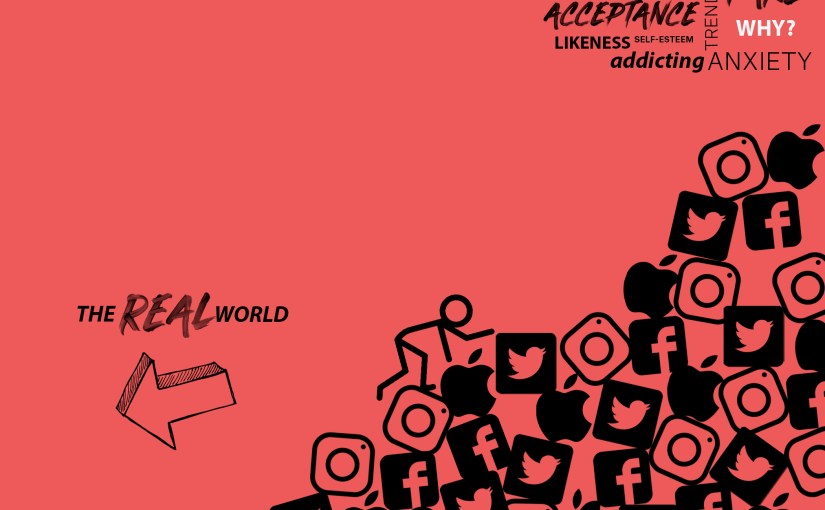
Have the Negatives of Social Media Overtaken the Benefits?
Throughout our childhoods, we flip the through pages of countless books. Books required for school reading and books for reading in a beach chair; books we love and can’t put down and books we hate and fall asleep reading at the kitchen table on a late school night.
I quickly discovered as a kid that people either love reading or hate it. There’s no middle ground. You were either the person waiting in line at a Barnes and Noble when the new Harry Potter book came out, or you weren’t.
I was the one waiting in line for The Deathly Hallows.
Growing up, I was surprised to always hear the same reaction from people about loving to read. People thought it was the worst possible way to spend free time.
“Oh, you actually like to read?”
But, more recently, I have discovered that even the avid readers have replaced those best-sellers with iPhone screens. We now live in a world where we digest information by scrolling endlessly through small blocks of 240 characters or less. We read opinions from thousands of people every day, some of whom we have never met.
Even authors, who write for a living, claim to be losing their reading endurance. Michael Harris, the author of Solitude: A Singular Life in a Crowded World, believes the “screen-orientated style of reading” has detrimentally impacted our old style of reading skillset.
“…Book-oriented styles of reading opened the world to me – by closing it. And new, screen-oriented styles of reading seem to have the opposite effect: They close the world to me, by opening it (Harris, 2018, p. 2).”
Books give our imaginations a new door into new worlds we never thought possible, all through the use of language. They take us to places where no one else can be, and in a way that opens the rest of the world to us after we put the words down.
Screens have a way of closing people off from the world, by giving them an entire world of information. With the stroke of a few keys, we can find the answer to any question instantly. By having the answers at our fingertips, our attention span is completely diminished. We no longer have to make our brain work. In turn, we have lost the ability to read well.
Interestingly, we aren’t reading less. It’s more so that we are reading worse.
“In a very real way, to lose old styles of reading to lose a part of ourselves (Harris, 2018, p. 3).”
Now the Millennials ask, or at least some of us do, have the negative effects of screens and instantaneous response officially outweighed the benefits? Will our children’s children ever hold a real book in their hands?
Generation Z’ers, whose first word was “iPhone,” do not see their lives as something related to the addiction to technology. “Generation Z addresses new technology as an “extension of themselves” rather than an addiction or compulsion,” (Vigo, 2019, p. 1).
Is it too late to turn back now?
DEEP READING -> DEEP WORK
One of the best skills we learn in school is reading comprehension. We learned to sit down, take notes and remember what we are reading. We had discussions and watched films about the books we studied.
This practice was especially difficult when you hated the book you were assigned to read. There were always books in high school that just did not appeal to certain students. We all remember the books we enjoyed and the books we hated.
1984.
That was the book. The book that I despised. I can still remember the smell of the overused paperback – old, grimy and depressingly gray, just like the plot.
I read it my freshman year and always thought it was introduced too early. I understood the overwhelming theme of “Big Brother” and how this was a prediction for what our world was going to turn in to (you weren’t too far off there, Mr. Orwell), but it was a complex plot to digest as a young freshman.
Despite wanting to throw 1984 behind me and move on to whatever Shakespeare play we were going to read next, I still remember it and I remember how it made me feel – anxious, depressed, confused. But, the deep reading/work that went into that project showed that even with books you don’t love, you can still understand them and retain the information if you work hard and understand deep work.
Deep Work by Cal Newport
“As intelligent machines improve, and the gap between machine and human abilities shrinks, employers are becoming increasingly likely to hire “new machines” instead of “new people,” (Newport, 2016, p. 23).
That’s a bit daunting, isn’t it?
Due to an unprecedented growth in the economy and technological world, restructuring is occurring. With this restructuring comes a divide among people in the “Intelligent Machine Age” – the high-skilled workers, the superstars and the owners.
The high-skilled workers work well with machines, the superstars are the top-notch group people that excel at what they do and the owners have the direct access to capital.
Newport gives us a few tips to help us survive in the ever-changing technological environment that we find ourselves in every day.
We must quickly master hard things while producing on an elite level with quality and speed.
Simple enough, right?
As a professional in the communication world, I have noticed that if you find yourself behind on “the next big thing” it is hard to catch up. The digital world changes every day, and in turn, you must also change and evolve every day.
One of the best tools you can use to stay current is YouTube. You have to be able to teach yourself as the world evolves around you, otherwise it will leave you behind…
______________
References: Cal Newport’s Deep Work; Michael Harris’ “I Have Forgotten How to Read”; Julian Vigo’s Forbes article “Generation Z and New Technology’s Effect on Culture”
 MAGGIE PRUITT