Student-Athlete Toolkit on Name, Image & Likeness

Student-Athlete Toolkit on Name, Image & Likeness: The Process

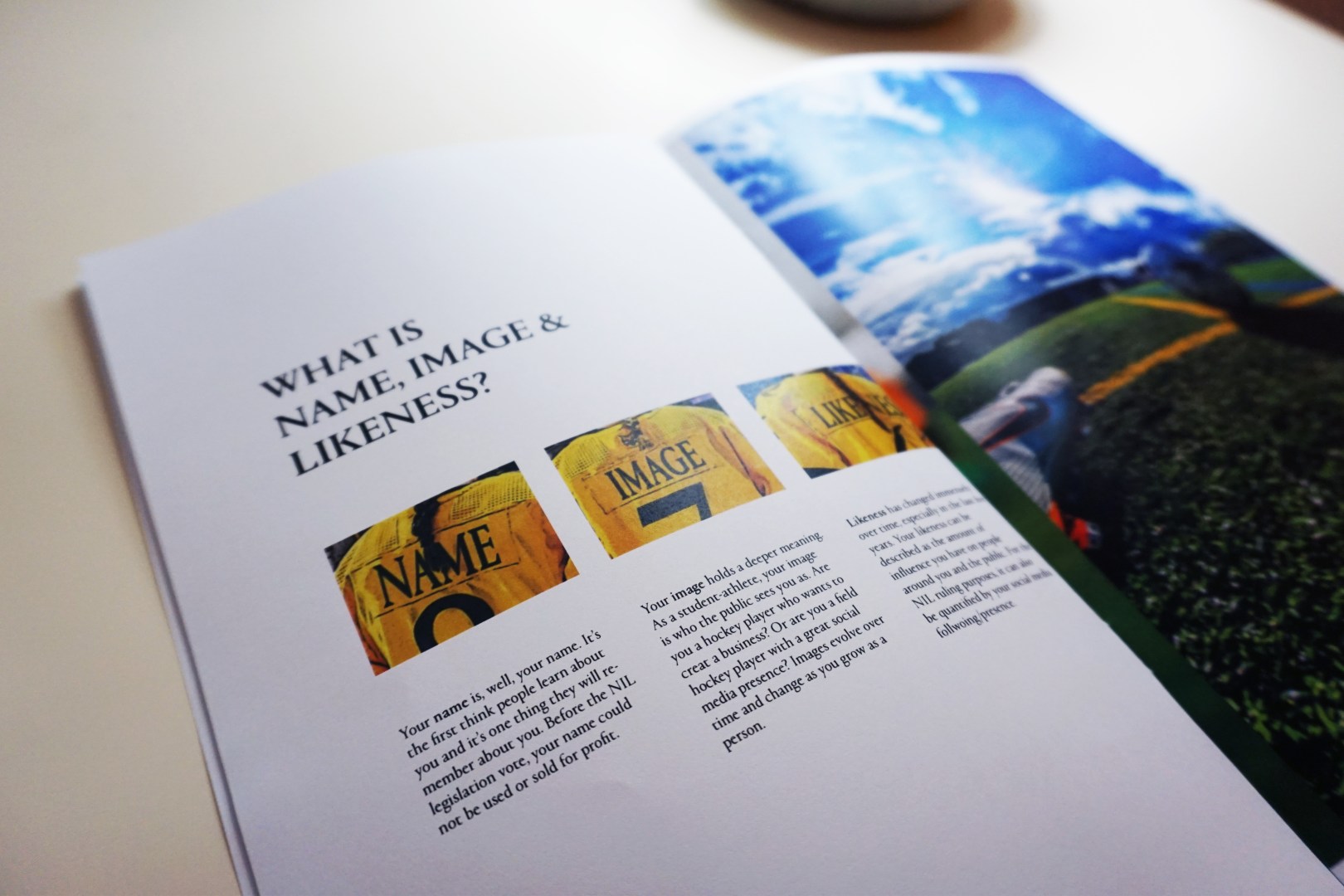
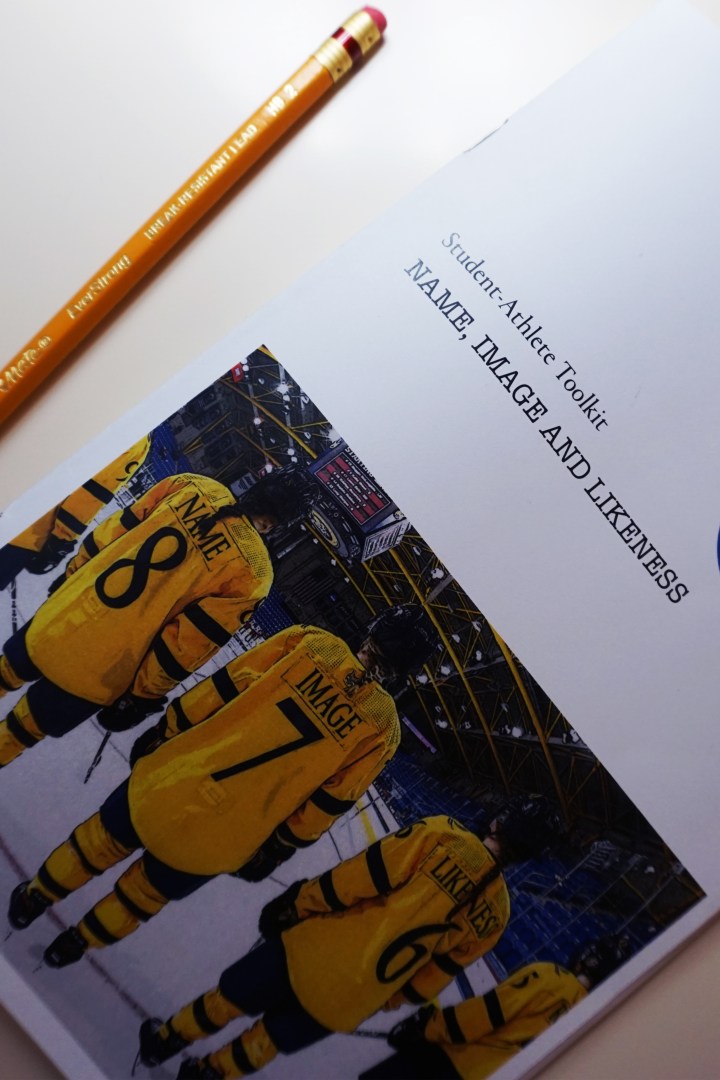
Over the course of a seven-week period, I created a toolkit for NCAA student-athletes on the evolving rules related to name, image and likeness. The toolkit was designed in the form of a booklet with information about student-athletes’ new opportunities to use their name, image and likeness to earn compensation – something that was previously impermissible for NCAA student-athletes to do under amateurism rules. 

From my experience working with student-athletes over the last three years, I have discovered that they don’t know a lot about what is and isn’t allowed as a student-athlete when it comes to social media. The goal of this booklet was to help student-athletes understand the opportunities they have once the new legislation goes into action in the fall of 2021. 

You will find the steps to my process below, along with links to blog posts from the past seven weeks and photos taken through the process. 

Student-Athlete Toolkit Project Proposal 

Blog: Project Management PlanMay 31, 2020

The proposal for my project was the skeleton for the end product. I outlined my ideas alongside the problem statement and added the information that needed to be included in the booklet. The proposal included my goal, which was to provide student-athletes a toolkit for when their opportunity to earn compensation off their name, image and likeness came into being. 

I laid out the essential information that was going to be included, and I planned the artifacts that were going to help me add key information for the booklet that I may not have found through research. 

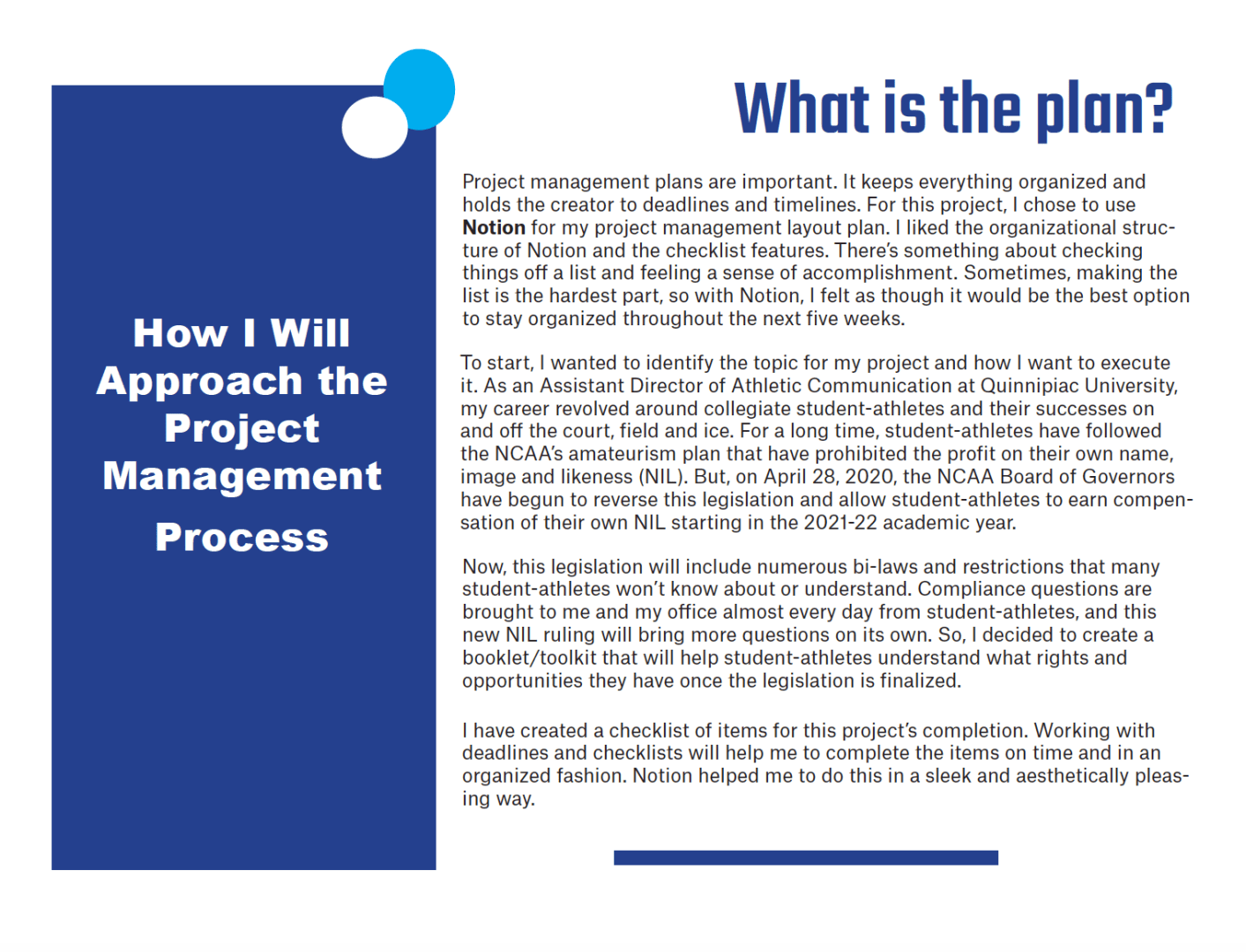
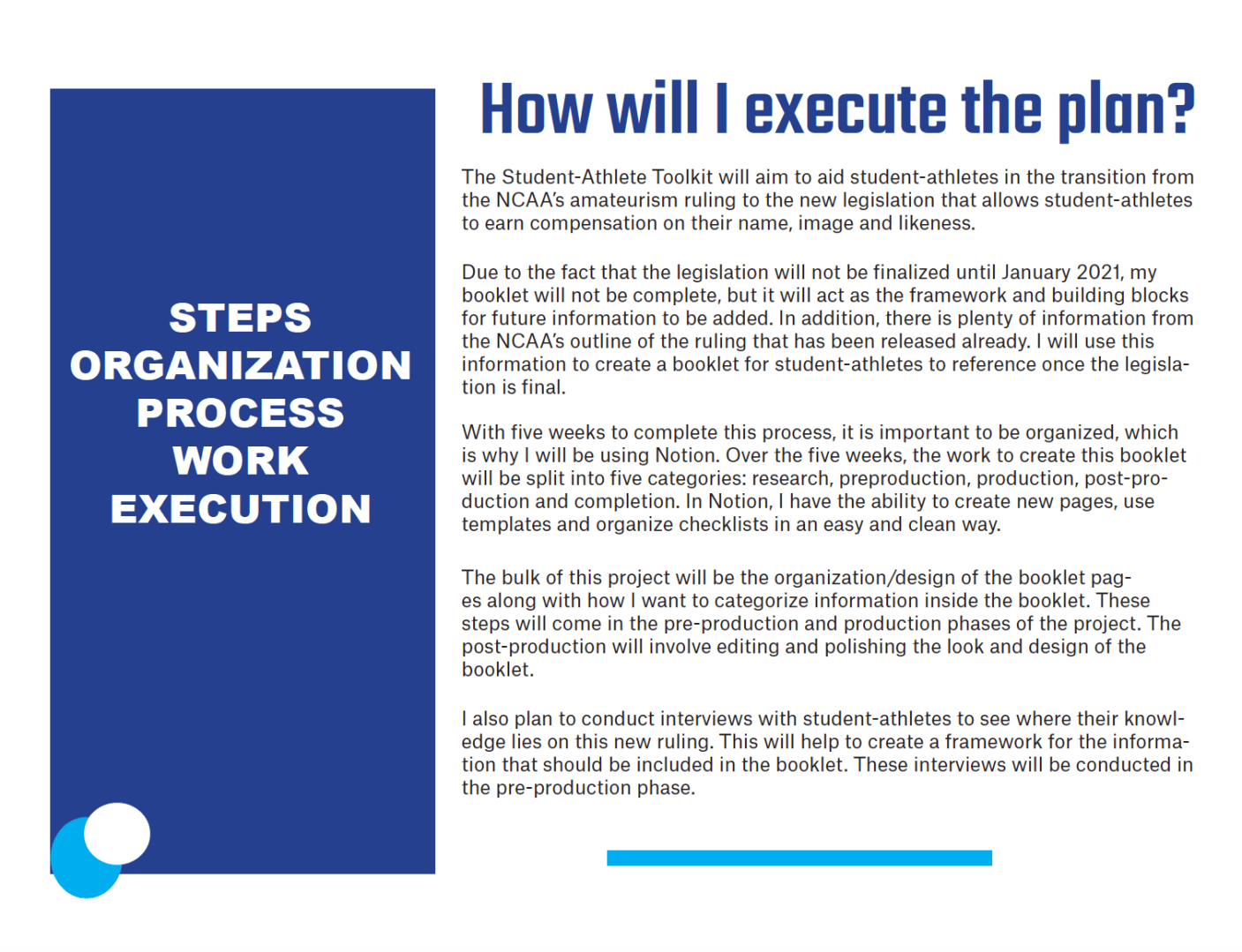
Here are a few parts of my proposal. 

I then broke down the specific questions that I, as the researcher and creator, would need to answer for the readers. I wrote out what my plan was going to entail: research, design & execution.
Research/Planning

Bibliography

In order to create a toolkit for student-athletes, I had to research about name, image and likeness. Working in college athletics and being a former student-athlete helped me to have general knowledge of the current restriction’s student-athletes have and what is being discussed to change. But, I needed to find out more and really breakdown what the new rules could look like in a language that is easier to understand than what the NCAA publishes. 

In addition, I used Notion to consolidate my plans and outline what I needed to do each week to finish the project. 

Artifacts 

Artifacts Blog: What is the Real Scandal Here?June 7, 2020

In order to gather more information about what student-athletes know about name, image and likeness, I went straight to the source. I interviewed four Quinnipiac student-athletes on a Zoom call and asked them about the old and new rules about name, image and likeness. The information they provided was very insightful and helped me design the information even more specifically for the toolkit. (I kept their names and images private for confidentiality.)

My first draft of the booklet was basic. It included the final copy that I knew needed to be in the booklet to provide student-athletes with enough information. But, the design aspect needed some tweaking. After rethinking the design, I changed the layout drastically and found inspiration from other sources that really helped me in the end. 

Cover 1 (left) | Final Cover (right)

In addition, a grid layout was used in the final draft. This created more of a magazine look-and-feel to the booklet.

Printing Process 

Blog 7 – July 2, 2020

After revising my first draft and completing the final draft, I then moved on to the printing process. I quickly realized that in order to print my booklet, I would need to become familiar with the InDesign feature called Print Booklet and the process of imposition. Imposition is the process of reordering your pages so that the first and last page are printed on the same sheet of paper. This took some time to organize, but I figured out that InDesign can create a PostScript File, which imposes a booklet for you. 

Basic Imposition Process

Student-Athlete Toolkit on Name, Image & Likeness 

Final Product

My final booklet came out to be 24 pages (12 sheets of paper). I printed the booklet on 8.5×11 paper with a 2-up Saddle Stitch. 
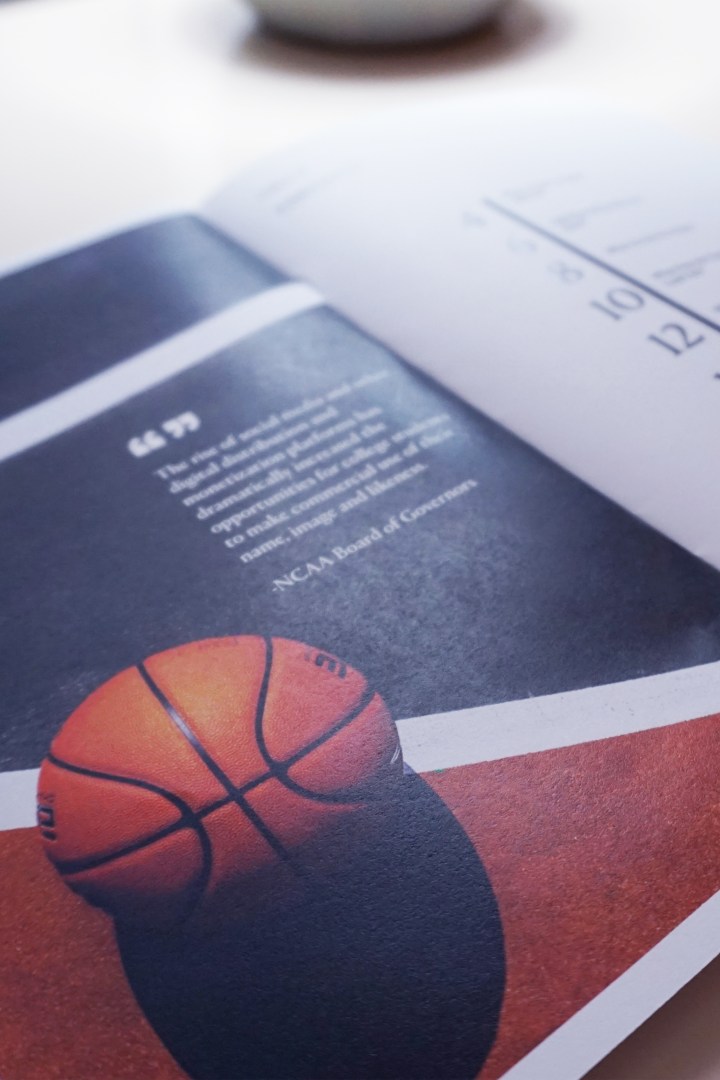
I believe my booklet is a great starting point for this evolving landscape in college athletics. I plan to add information as it released to the public over the next few months as the NCAA Board of Governors continues to vote on different aspects of the legislation.   

You can see a PDF version of my booklet HERE:

The Fourth Quarter

Growing up, I was always taught that too much white space is a bad thing. You had to fill the entire page in school to show that you were writing enough and had enough information. In design or blank space, white space is your best friend, and I forgot that.  

The past couple of weeks have been difficult. I lost a lot of my creative energy and found it hard to complete the assignments for my graduate school class. But, after some Google searching and a meeting with my professor, I felt refreshed. I was ready to redesign my Toolkit for NCAA student-athletes about their name, image and likeness and have all of the white space that I needed.

Pages 4-5 in Student-Athlete Toolkit on Name, Image & Likeness

I discovered a photo sharing website called Unsplash, which is a photo gallery community where photographers share their high-resolution pictures and anyone can download them and use them for free. This website is home to over one million beautiful photos and really helped me with my redesign. 

My professor also helped recalled information that I learned in my undergraduate time in my newspaper, yearbook and publishing classes. The grid structure of Adobe InDesign helps create a uniform look and feel for the document. I went with a three-column structure for my copy and photos throughout the toolkit. This also helped my mind become less cluttered and unorganized by giving myself something more to work with.

Adobe InDesign
Grid Structure from Thinking With Type

The purpose of this toolkit is to help student-athletes understand the potential gain and the dissect the vague restrictions behind the NCAA’s name, image and likeness ruling. Now more than ever before, social media will be a student-athlete’s best tool to use once the collegiate athletics world merges with the $5-10 billion influencer business. (Planos, 2020).

Social and digital media played a significant role in these proposed changes, according to the NCAA Board of Governors’ meeting report from April 17.

“The rise of social media and other digital distribution and monetization platforms has dramatically increased the opportunities for college students to make commercial use of their NIL.”

NCAA Board of Governors meeting | April 17, 2020

And it looks like the NCAA is truly trying to make this all happen, but with their own guardrails. The NCAA has stated in their initial decision to move forward with compensation rules that endorsements student-athletes can receive will be independent of athletic activity and not an endorsement payment for athletic activity. The NCAA says there will be regulations on third-parties or agents, but they do not provide any further details (Sallee & Silverstein, 2020).

Conferences are trying to push for this to happen, too. The Power Five conferences spent $350,000 on lobbyists to attempt to influence Congress on legislation allowing collegiate student-athletes to earn endorsement money, which was more than they have previously spent in any full year. The Southeastern Conference spent the most out of any conference – $140,000 (Nuckols, 2020). 

“We look forward to a constructive exchange of ideas about ways we can further enhance our student-athletes’ educational and athletic experiences while ensuring that any future changes can be administered fairly on a national level.”

Greg Sankey, SEC Commissioner

According to Nuckols, the SEC has never employed Washington lobbyists and left the work for influencing Congress to the universities and the NCAA until now.

And as we could have predicted, student-athletes are involved in the legislation process, as well. Current and former collegiate student-athletes across the country are a part of the working group with the NCAA that will help provide information and experiences related to earning money for their name, image and likeness during the time when that was impermissible. 

“We’re the solutions group,” Jaila Tolber, former student-athlete at Virginia Tech said about joining the working group. “So, coming up with some kind of framework is going to be a huge part of our plan. My goals are to make those recommendations that align with the NCAA principles and allow student-athletes to benefit from their name, image and likeness. Having that same access that regular students have. 

Looks like there are a lot of people in this process who have student-athletes’ best intentions at heart. Let’s keep the momentum going forward.

Name, Image…Income Tax?

On April 29, 2020, the NCAA Board of Governors supported rules changes to allow student-athletes to have opportunities to receive compensation for third-party endorsements. And on July 1, 2021, the NCAA finally approved and finalized the ruling and for the first time in history, collegiate student-athletes are allowed to earn compensation on their own name, image and likeness deals.

Student-athletes have many opportunities to earn compensation, if they so choose. For many of the bigger and more valuable deals, student-athletes will need to look into having an agent or third party involved in this operation. It will be difficult for student-athletes to negotiate deals with businesses, sponsors and other entities without having any experience in this type of business. 

In addition, compliance offices are now busier than ever trying to manage the influx of questions about NIL ahead of the 2021-22 academic year. It will be important for student-athletes to know that compliance offices will have some answers, but not all. University employees won’t be able to help student-athletes negotiate deals or help find opportunities; the compliance office can only regulate per the NCAA’s evolving ruling. 

Male and female athletes will have the same rules, guardrails and regulations provided by the NCAA. Everyone will be on the same playing field and level. Student-athletes will all have the general opportunity to earn compensation for their name, image and likeness, but the number and value of opportunities will vary immensely. There are many factors involved with how and why student-athletes could receive more money than others. 

I conducted an ample amount of research in June of 2020, and I realized that there will not be a general framework for student-athletes to follow. There is not a model that can be replicated for each athlete’s situation. Every athlete’s situation and opportunity for compensation will be different. 

The NCAA has a tall task ahead. I do believe the implementation of these new rules is moving the collegiate athletic experience in the right direction, but there will be a lot learning along the way. In addition, the NCAA has not had the reputation for “sticking to their guns”.

“For decades, the NCAA and its members considered cost-of-attendance stipends anathema to amateurism. And then they didn’t. That pretty much describes the NCAA attitude toward amateurism throughout its 115-year history.” (Maisel, 2020).

Student-athletes have already shown what the power of social media brings to the table. The name, image and likeness ruling will help out student-athletes who have major numbers in followers but don’t go to a Power Five school.

“For example, Phoenix Sproles is a wide receiver at North Dakota State University and has 147 thousand followers on Instagram and Tik Tok, which is by definition an “influencer/star status” (Cousin, 2020).

The power lies with the student-athletes. The problems come as the NCAA will attempt to regulate the opportunities to comply with Title IX rules and keep things fair, which isn’t totally a bad thing. It will just be difficult. 

There are so many factors that go into student-athletes compensation opportunities:

-Institution

-Sport played

-Social media followers

-Geographical location of school 

-Competition with other schools 

Let’s not forget that student-athletes will have to file taxes on the money they earn.

“We have discussed the impact of name, image and likeness in our director’s meeting, but we didn’t even think about the tax implications,” said Jeff Pritsker, Assistant Athletic Director for Business and Administration at San Jose State University (Davis, 2020).

An example of how this would work with student-athletes includes a student-athlete receiving a car from a dealership for a year after appearing in commercials. As with any normal taxpayer, a return must be filed if a student-athlete makes $400 from self-employment. 

This will also get messy when a student-athlete is from one state, but attends a school in a different state. 

“For example, a student-athlete from a high school in Georgia (which has a state income tax) enrolls at a university in Florida (which does not) and plays for the football team. He receives free meals from a restaurant in Florida in exchange for endorsing the business. If the athlete is still considered a Georgia resident by that state’s laws, the benefit is considered income subject to Georgia’s state income tax even though the activity took place in Florida” (Davis, 2020).

This is going to get crazy.

Amateurism Transition

The NCAA has had a long history of maintaining amateurism rules in the realm of collegiate sports. Because collegiate student-athletes are amateurs, up until July 1, 2021, you were not allowed to be compensated for anything that involved your name, image and likeness. Earning compensation would throw you into the “professional” category and you would be deemed ineligible to compete for your school. This includes get paid to sign autographs, earning compensation for a sponsorship, advertising a brand on your own social media, profiting off your own jersey sales and pay-for-play situations. There are so many other examples, but those are some basics.

In January 2021, the NCAA Board of Governors voted on the name, image and likeness ruling that has been in debate for a few years now, and, after months of debating, student-athletes now have the opportunity to get paid for outside endorsements and compensated for name, image and likeness qualities. 

Back in the summer of 2020, I was able to talk to a few of the student-athletes I work with every day about NIL. It was interesting to hear what student-athletes did and did not know about related to the debate. Their understanding of name, image and likeness rules in relation to social media, outside companies and brands was basic. In the past, the student-athletes report to their coaches, compliance officers or athletic communication directors when they have question about an NCAA rule. In a lot of cases, those administrative positions sometimes don’t have all of the answers either. 

Basically, the NCAA’s rules don’t have all of the answers because the lifestyles of collegiate student-athletes have changed immensely, so the rules don’t always align to what is going on, especially in the social media world.

So, when the new ruling was voted on and successfully implemented for the 2021-22 academic year, people wondered how will student-athletes know what their opportunities are? The universities and institutions won’t be allowed to take any part in the student-athletes’ business relations.

Jill Bodensteiner, the director of athletics at St. Joseph’s and member of the NIL Committee, mentions student-athletes having the opportunity to take classes like sports management, marketing and digital storytelling at their schools (Rueb, 2020). That would be great, but, what if you have a student-athlete who has a heavy course load in, for example, a pre-med track and can’t afford to take one of those classes?

We also can assume that this process won’t be a free-for-all right from the get-go. These rules will have to be slowly implements and then examined after they are live. Things will be adjusted and changed over the course of the first couple of years. The NCAA also left up a lot to interpret in the opening legislation. 

“… If you couple the name, image and likeness to a (proposed) one-time transfer, what’s to say that the University of Alabama likes my player and they come to him and approach him on a side deal? ‘Listen, come here, we’ve got this car dealer that’s going to pay you $50,000 a year to advertise for them and you’ve got an opportunity to win a national championship and you can play right now.’ That’s more like the wild, wild west in my opinion.”

Louisville head football coach Scott Satterfield

The rules the NCAA will create must be air-tight when it comes to recruiting. The goals of this new legislation are not to really change the landscape of recruiting that dramatically, and without strict rules, it very well could. 

Student-athletes should have resources that can help them through this process if they so choose. If you are a student-athlete, you must keep in mind that there are only a small number of athletes that could earn life-changing money. For student-athletes with smaller followings, the money they could earn is not substantial. 

This chart displays estimated profits for student-athletes with different social media followings and sports played.

I think student-athletes will find that the work that would need to go into earning compensation and advertising for brands is not worth the return. In my Zoom interview with five student-athletes I work with, all of them mentioned not being involved in searching for money-making opportunities during their playing seasons. They all said it would be a distraction during competition season, and they mentioned it could cause drama within the teams. 

But, that does not mean they shouldn’t be educated on what their opportunities could look like. Breaking down the rules, what they were and how they changed, will help student-athletes know and what to expect as they progress through their time as a student-athlete. For some, this time of playing for an educational institution would be the closest thing they could have to playing professionally, as well, especially for female student-athletes. 


Why not try and earn some extra money?


What is the Real Scandal Here?

In 2019, college football and basketball coaches were categorized as the highest-paid public employees in 40 states (Hruby, 2020). According to USA Today, Nick Saban, Ed Orgeron and Dabo Swinney are the three highest paid coaches in college football. Together, their earning top 26.5 million dollars.

Up until July 1, 2021, the student-athletes who are physically doing the hard work, were not allowed to earn compensation on their own name, image and likeness. 

Illustration by James Clapham – The Washington Post

The ruling went back-and-forth between the federal government, individual state’s governments and the NCAA. Not to mention, the fans who have no stake in the game whatsoever, had plenty to say.

There has been a very distinct split of people for and against this new name, image and likeness ruling. Despite coaches getting paid the big bucks, student-athletes did not get a chance to receive anything more than the value of their scholarships and a little cost-of-living change (Hruby, 2020). 

One side says…student-athletes are already spoiled and don’t deserve to make more. They don’t recognize the worth of their scholarships. 

On the other hand, there are those who agree with Pulitzer-Prize winning civil rights historian Taylor Branch who argued that NCAA amateurism was vastly unjust. 

“…a bill attainder, stripping from college athletes the rights of American citizenship.” -Taylor Brand in “The Shame of College Sports” from The Atlantic

Over the course of 15 years, the collegiate sport industry’s revenue rose from $4 billion to $14 billion, and in the end, student-athletes don’t benefit from the earnings at all (Hruby, 2020). Brand explains in his 2011 story for The Atlantic that, yes, student-athletes are taking money and benefits under the table, but the real scandal is within the structure of NCAA amateurism and college sports in general. 

“…a bill attainder, stripping from college athletes the rights of American citizenship.” -Taylor Brand in “The Shame of College Sports” from The Atlantic

Breaking down the revenue generated from the Southeastern Conference (SEC), which was the first conference to crack a billion-dollar earning mark in 2010, you have numerous aspects of a gameday experience that bring in wheelbarrows of money. The money conferences earn together come from concession sales, ticket sales, merchandise, licensing fees and other sources. The bulk comes from television contracts (Brand, 2011).

Outrage comes when schools and student-athletes are found to have violated NCAA rules. The institutions lose Bowl and post-season eligibly, student-athletes can lose out on their future seasons and a dark cloud of shame is posted over those institutions for years to come. 

“For all the outrage, the real scandal is not that students are getting illegally paid or recruited.” Branch said. “It’s that two of the noble principles on which the NCAA justifies its existence—“amateurism” and the “student-athlete”—are cynical hoaxes, legalistic confections propagated by the universities so they can exploit the skills and fame of young athletes.”

-Taylor Branch, The Atlantic

On June 4, 2020, I sat down (virtually, of course) to talk to a few student-athletes of whom I work with every day in a normal week at Quinnipiac. They were all female and all play on the same team. I was curious to know what they already knew about the name, image and likeness rules and how I could take the information they gave me to apply it to my NCAA NIL Student-Athlete Toolkit.

A few things I discovered:

-The student-athletes knew the basics of what exactly name, image and likeness means.

-They knew the very basics of the old name, image and likeness rules. If approached by an outside party/sponsor about promoting a brand, they all knew to double-check with myself or our compliance office before taking any action. They knew they were not allowed to post anything on social media that promoted a brand that was not Quinnipiac. 

-One student-athlete brought up California being the first state to bring up legislation about student-athletes being able to compensate off their NIL before the NCAA.

-When asked if they would be open to taking advantage of opportunities that may come to them in a year, they said they would be open but “wouldn’t go out looking for them” and “would not want the added distraction during competition season”.

-They did not know about the new rule about institutions not being allowed to be involved in these new opportunities. 

-They mentioned that they don’t follow the NCAA on social media, and they normally get the new information from teammates or coaches.

From the information I gathered, I created the Table of Contents for the Toolkit:

Section 1: What is Name, Image and Likeness?

            This section will explain the basics of what NIL is and how it pertains to student-athletes. 

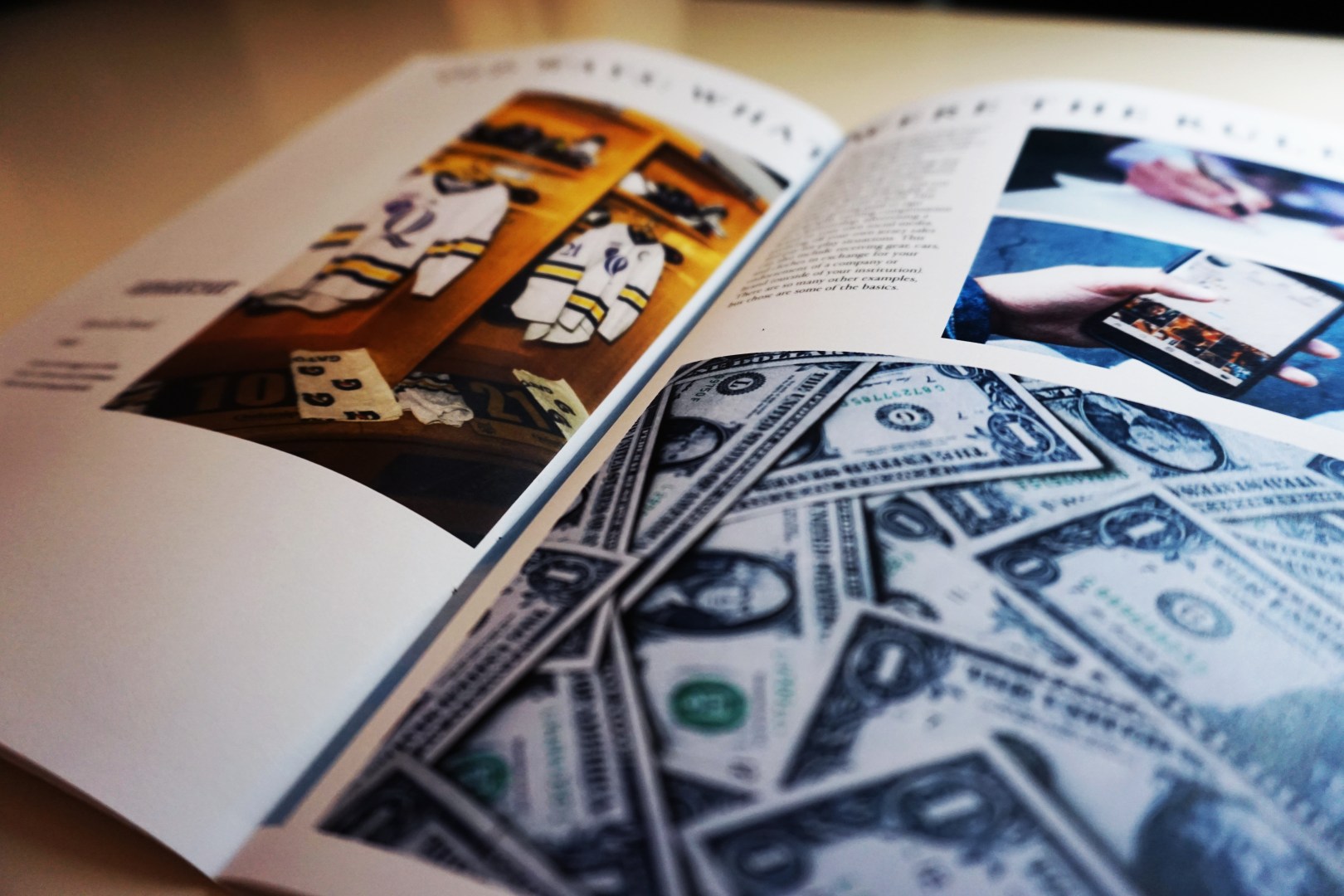
Section 2: Old Ways: What Were the Rules?

Section 2 will briefly explain what the old rules were, and how the new legislation came to fruition, including the California law. 

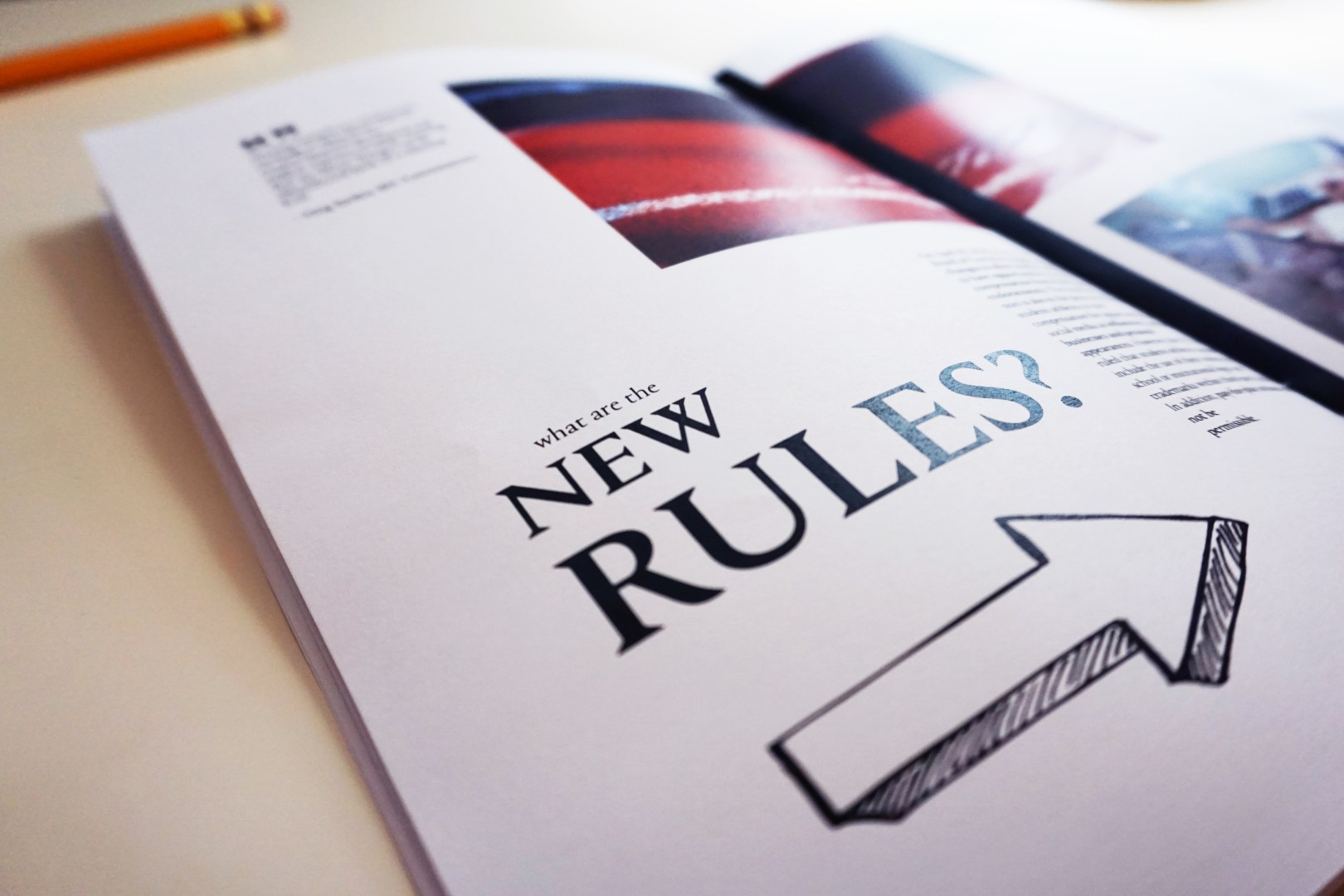
Section 3: What Are the New Rules?

This section will be two pages (leaving room for the new rules that are added down the line) and will explain in easy-to-understand language what the new rules entail. 

Section 4: What Does the Timeline Look Like?

This section will explain the voting timeline and when student-athletes would actually be able to being compensating off their NIL.

Section 5: What Opportunities Do I Have?

Section 5 will give examples for student-athletes to think about how they could profit off their NIL. From Instagram posts to signing autographs, there are many different ways student-athletes can earn money.

Section 6: What Will These Opportunities Involve?

How exactly will student-athletes make relationships, money and how will they deal with contracts? Will they need third parties’ involvement? This section will go into what is needed to make an opportunity happen.

Section 7: Differences for Male and Female Athletes?

There is no difference in the rulings for male and female student-athletes. But, this section can help female athletes understand the opportunities they have due to not having the same professional career opportunities that male student-athletes have after school.

Section 8: How Much Money Could I Realistically Make?

This section breaks down a chart from FiveThirtyEight that explains how much money student-athletes could potentially make based on their school, sport and following.

There is a lot of information to break down, but after hearing what student-athletes had to say about this ruling, I think it is essential to make the language easy to read. Breaking down the rules and the timeline will help student-athletes learn what is possible for them.

During this week of organization, I also created a Production Journal on Adobe InDesign. The Production Journal acts like a check list for each week in the remaining four weeks of the class.

Project Management Plan: Student-Athlete Toolkit

Project management is important. It is how creators stay organized and accomplish tasks in a timely manner. Notion is a cool project management system that I decided to use for my project management process to develop a toolkit/booklet for NCAA student-athletes and the new name, image and likeness rules. 

Research 

The research phase of the project process will be ongoing and growing throughout the next five weeks. An annotated bibliography will be used to compile all research tools and sources throughout the process. On Notion, I noted the week-by-week process of adding annotations to the bibliography. 

Pre-production 

This phase of the project will include planning out pages and information, along with conducting interviews with student-athletes at Quinnipiac. This phase will be used to prepare and organize information before the production phase. I am interested to see what student-athletes know about the NCAA name, image and likeness regulations. The information I gather from the student-athletes will be used to decipher what information is especially important to use in the booklet. 

I came across the National College Players Association and was curious to see if student-athletes know what that organization is. The mission of the NCPA is to protect future, current and former college athletes. The NCPA is a great resource for student-athletes, but I am not sure many even know about it. I will use the Zoom interviews to see what they do know.

Production 

The production phase will include assembling the pages of the booklet in an Adobe InDesign document. InDesign is part of the Adobe Creative Cloud suite and is an awesome software for desktop publishing, so I decided to use that for the booklet. 

I will have to organize the booklet based on the information the NCAA has released and stated in the new rulings, and what information seems to be necessary for student-athletes.

Post-Production 

This phase will include editing the booklet and proofreading. Reorganization of pages could be needed, so this phase will be essential after I have gone past the first three phases. 

The Proposal: Student-Athlete Toolkit

Since the inception of the NCAA, student-athletes across the country have played the sports they love at an amateur level. An amateur engages in a pursuit or hobby, most often a sporting competition, on an unpaid level. 

NCAA and individual compliance offices have monitored the benefits that student-athletes have received for decades. As the influential platforms of social media grew, the compliance jobs proved to be more difficult as student-athletes have a public forum for their name, image and likeness. The restrictions that student-athletes currently have include influencing a brand or company that is separate from the student-athlete’s institution. 

Basically, student-athletes cannot act as influencers. But, the main problem here lies with the large amount of money that the NCAA and institutions make off of student-athletes’ success. 

Zion Williamson played one season of basketball at Duke University during the 2018-19 academic year. He is regarded as one of the most electric, young basketball players to watch since LeBron James in the early 2000s. The “Business of Zion” as Michael Smith put it in the Sports Business Journal, was created from Williamson’s influence on social media, TV viewership, ticket sales and the sneaker industry. 

Photo: GETTY IMAGES

In ESPN’s most-watched game of the year, Duke vs North Carolina, Williamson infamously got hurt after running a hard cut that tore his Nike sneaker. That incident proved to be “ground zero for debates on the NBA’s one-and-done rule and amateurism in college” (Smith, 2019). The average price for this consistently-anticipated rivalry game went for $3,200. And when the Blue Devils hit the road, ticket prices jump 194 percent (Smith, 2019). Everyone wanted to see Williamson.

The superstar has over 2.6 million followers on Instagram and Twitter combined. Influencers, or people with more than 1 million followers, can make up to $20,000 per post according to the Sports Business Journal. But, at the time when Williamson was a Blue Devil, he would not have been allowed to act as an influencer. 

Many debates have sparked after Williamson’s injury about amateurism in college athletics and student-athletes’ limited opportunities to play professionally, especially with female athletes. On April 28, 2020, the NCAA Board of Governors took a step forward in the ruling and outlining of specific categories in which student-athletes can have the opportunity to earn compensation for their name-image and likeness (NCAA, 2020). 

The new rulings state that “student-athletes are able and have the opportunity to receive compensation from third party entities/endorsements related to athletics that are separate from the university, school and conference” (NCAA, 2020).

The second ruling states “compensation for other student-athlete opportunities, such as social media, new businesses and personal appearances, without institutional involvement or the use of trademarks/logos” (NCAA, 2020).

This is a massive change to rulings that were very strict beforehand. As an Assistant Director of Athletic Communication at Quinnipiac University, I work with student-athletes and social media very closely. Before this new legislation passed by the NCAA, student-athletes could not even tag brands in their personal social media posts. I work to make sure student-athletes are in line with the current NCAA amateur rules to maintain their eligibility.

By the 2021-22 academic year, the final legislation will be ready to go and student-athletes will be allowed to compensate off their name, image and likeness. But do they understand what this means? Do they know their rights and abilities? 

I plan to create a booklet/toolkit that will aid student-athletes in this interesting transition. This toolkit will help student-athletes learn what exactly the new ruling is about and how they would be able to use it, if they so choose. 

There are plenty of restrictions that will come with this ruling and the student-athletes should have all the information in ways that are easy to understand. 

There is also a reality to understand once this legislation is passed. Some athletes won’t really be able to benefit. Everyone won’t get to be an influencer. There is only a small group of athletes that will earn a large amount of money. According to a projection created by FiveThirtyEight, there are seven student-athletes (a few just coming out of high school) that are projected to earn more than $1,000 on a post. 

This is due to the number of followers they have, the sport they play and the institution they are at or are planning to attend. Paige Bueckers is a rising freshman set to play basketball at UConn. She has the potential to make a total of $670,783 off her social media posts alone. With over 500,000 followers and a post value of $20,000, she could benefit immensely from the name, image and likeness ruling. On a different side, Mikayla Colohan is a soccer player at BYU with a little over 2,000 followers on Instagram and has the potential to earn $267…not the same earnings, but still earnings at the least.

As you can see, there are various earning levels that athletes can have. I am not sure how this ruling will play out. And next year, as an employee of an athletic department, I won’t have the opportunity to help student-athletes will this ruling, except for explaining violations. The new legislation won’t allow any involvement from the student-athletes’ institution in the instrumentation of compensation from outside parties.

I hope this booklet with be something to help student-athletes understand more about the ruling and opportunities they will soon have with their name, image and likeness.

Final Project

Final Reflection

This course was very useful to me as a communication and creative professional. I learned how to work outside-of-the-box for numerous projects due to the COVID-19 pandemic. I had to think on my feet and use tools around me that were not necessarily tools that I would have used during a normal semester.

There are no right and wrongs in the art of moving pictures, but there are techniques and skills that help tell stories more effectively. Being able to take criticism will also help to grow as an artist. 

J Cuts

Here is an example.

In this scene, the jump cut occurs at 0:14 seconds. A jump cut happens when there is an abrupt transition from one scene to another. 

L Cuts 

An L cut is a film editing technique where the audio from a scene precedes the actual video footage. Here is an example.

In Ferris Bueller’s Day Off, the teacher calls roll and the camera jumps to the next shot of the desk chair. The teacher’s audio is still playing in the next shot. Another L cut happens in the same shot when the classmate starts talking while the shot is still on the desk.

Final Project 

Link

In this final project, I interviewed my friend Sara MacDonough-Civitello. She is an athletic trainer at Quinnipiac University for the men’s basketball team. I interviewed her about the day the sports world stood still (when all collegiate sports were cancelled due to COVID-19). 

The b-roll is from Quinnipiac’s main campus and York Hill campus. All footage was filmed by me. 

Module VI

Module 6 

Read to Inform

Storytelling – social and cultural activity of sharing stories and passing information on 

Documentary Film – a documentary is a non-fictional film that is intended to show real-life events and people in order to inform, entertain or maintain a historical record 

How to Make a Documentary 

  • Tell a story you care about
  • Research: Having a plentiful amount of information will help tell a captivating story 
  • Make a Plan: Have an idea of the style and structure for your documentary 
  • Create a Shot List: Having a list of footage and shots will help make your shooting organized and efficient
  • Start Shooting 
  • Write a Script: A script not only includes voice over lines, but also information about what the viewers are seeing 
  • Begin Editing 
  • Check Legal and Copyright rules 

13 Rules for Making Documentary Films 

  1. Fight Club Rule
  2. Don’t make a documentary about things people already know about (example – nuclear power is bad)
  3. Don’t imitate a college lecture 
  4. Give viewers something they will enjoy
  5. Don’t be boring
  6. Why don’t more documentaries go after the real villans?
  7. Make it Personal 
  8. Point your cameras at the media 
  9. Books and TV have nonfiction down, go after that
  10. Try to film people who disagree with you 
  11. What you feel, the audience will feel 
  12. Less is More 
  13. Sound is the most important feature

Cat Trap King – This documentary was interesting, engaging and effective. The 60 second film gives viewers a quick look at a human-interest story. The voice over tells the story while showing b-roll of the subject. 

Skater Girl – This documentary shows b-roll of a young girl skating at a very high level. This documentary showed a feel-good story and made you feel happy after it was over.

Wedding Video – The video shows a couple’s wedding day. The video starts off with the groom stating his vows as the voice over and introduction to the video. Then, it switches over to the bride’s vows as the voice over while showing scenes from the wedding day.

Mailboat Jumpers 

This news package was really interesting. I had never heard of mailboat jumpers before, and this story was really cool. The narrator takes the viewers through the story of what mailboat jumpers are and what their duties are. Then, interviews give viewers an added look at what jumping is all about. The script is the same as the press release that goes with the video, and the photos are the storyboard. 

Steam-Powered Cider Mill story – The first part of this video is about the history of making cider in Mystic, Conn. The second part of the story is about the owners of the steam-powered cider mill and their cider donuts. The third part of the video is about the ingredients in the cider. 

Sprinkles Cupcakes – The images in this video are not as clear as they probably could have been. But, because it was 2005, the image quality is understandable. I didn’t notice the introduction interview being poor; I thought it was ok. I thought the red velvet b-roll could have been ordered a little differently so that the viewers were aware she was going to talk about red velvet cupcakes before she did. I thought someone on the street waiting in line for a cupcake would have made a cool interview piece to add to the video. 

Old Amusement Park – This video opens with a voice over that narrates the story, followed by interviews. The b-roll shots are aesthetically pleasing with the fall foliage in the background.

Geologist – This video uses the “rock” theme to add lower thirds to the video. This video uses b-roll to show viewers what the geologist would do outside. 

Two speakers – The first speaker’s audio picks up all of the outside sound around the portable speaker on the podium. I think the editors replaced the audio from the normal video with what they picked up on the recorder. You can hear the papers rumbling below. The second speaker has a lav mic on, in addition to the standing mic, so his sounds clearer. 

 Quinnipiac Graphic Design program – This video tells a story with the voice over guiding viewers about the program. 

Top 100 Documentaries – I have seen Blackfish as just an example from this list. It was a really interesting documentary, and I actually almost started an organization in college to help save the sea life in captivity. And that’s one of the main results people who make documentaries strive for. 

Examples 

Michael Jordan Documentary (Trailer) – The Last Dance 

This trailer for the 10-part documentary is just a small example of the extraordinary footage and interviews that the now-airing documentary is showing. The trailer hooked me as a viewer with footage that I had never seen before as a basketball fan. 

Beyoncé’s Homecoming – Netflix Documentary 

This is my favorite documentary to date. As a fan of art and music, I was blown away by the creative team that made this film. It is a combination of behind-the-scenes footage of Beyoncé’s work on her show at Coachella in 2018. The trailer shows a small part of that. The creators made you feel like you were there at the show. 

Pre-Production Document

Readings 

Chapter 7 – Lighting

The most powerful source of light is the sun, but because it’s always moving, it is difficult to work with. A reflector is anything that reflects light, and a fill light is artificial light set up to put out daylight-colored light.

There are three basic types of lighting – focusing quartz, broads and softlights. The focusing quartz light is the spotlight used in movies and in tv shows. Broads are non-focusing lights designed to cover a large area with even light. Softlights are permanent, portable bounce lights.  

Chapter 9 – Doing It

A shooting script is a list of what you are going to shoot and how you are going to shoot it (wide shots, close ups). Communication is key – in order for a shoot to go smoothly, someone has to be in charge and direct the shoot. It is also important to be able to work in uncontrollable situations.

Module V

Module 5

Research to Inform

Continuity editing is the process of combining related shots or different components cut from one shot into a sequence. 

A how-to video shows viewers step-by-step how to do something. 

Videos with multiple angles:

Date Night – This scene in Date Night with Steve Carell and Tina Fey shows a classic diner scene with two characters talking. The shots include a standard wide shot of the two characters in the booth and over-the-shoulder shots. The conversation is a great example of the 180-degree line rule. The plane down the center of the actors stays on one side during the entire conversation. It is definitely more interesting to see the emotions and facial expressions of the actors not talking, rather than have the shot always on the actor talking. 

The Matrix – In this scene, there are many “match on action” shots that show one part of the scene and then extend the cut to show more. For example, when Keanu Reeves goes to open his coat, viewers see a small cut of him unbuttoning before the main shot to see what is in his overcoat. 

Filming a Guy Playing a Guitar – The angles in this video are beautiful. There is a great variety of close-ups and wide shots, in addition to the varying speed of the shots. It flows nicely together. 

How to Make a Paper Balloon Water Bomb – This video used multiple angles to give the video variety and kept the shots interesting. 

Reading

Chapter 3 – Viewers find it easier and more appealing to look at different images of a sequences with many angles, rather than looking at the same angle for a long time. Wide shots, medium shots, and close ups are all examples of shots that create variety in a video. When shooting a sequence, your shots should involve a change in image size and camera angle. A jump cut occurs when you only change the size of the image in the frame. Cutting the action helps create variance and keeps the viewer’s eyes active.

Chapter 4 – In video, there is a line between characters called an axis of action. When shooting characters, you should stay on one side of the line and be weary not to cross it. Keeping the screen direction consistent will help you to stay on the right side of the axis of action. 

How to Video

Link – How to Make a Homemade Mask

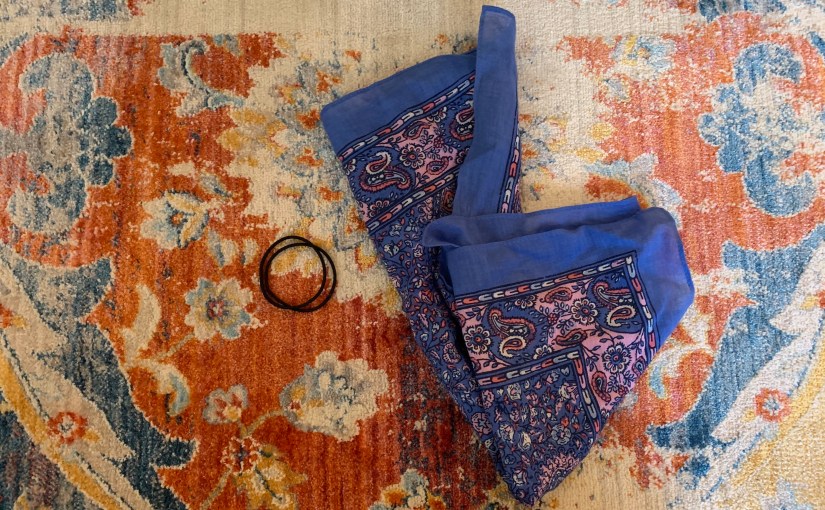
This video is about making a homemade mask for when you have to go into public during the pandemic of COVID-19. All you need to make a mask is a bandana and two hair ties.

I used multiple angles in this video to show the simple directions for making a mask.