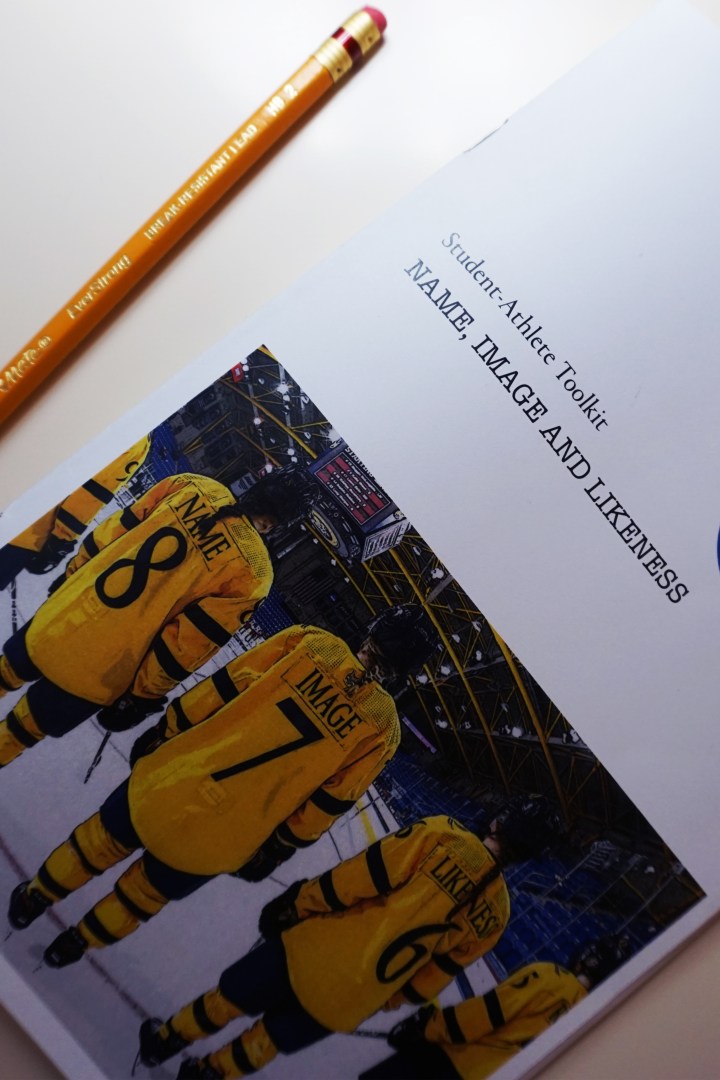
Dear Data: Insta Inquiry

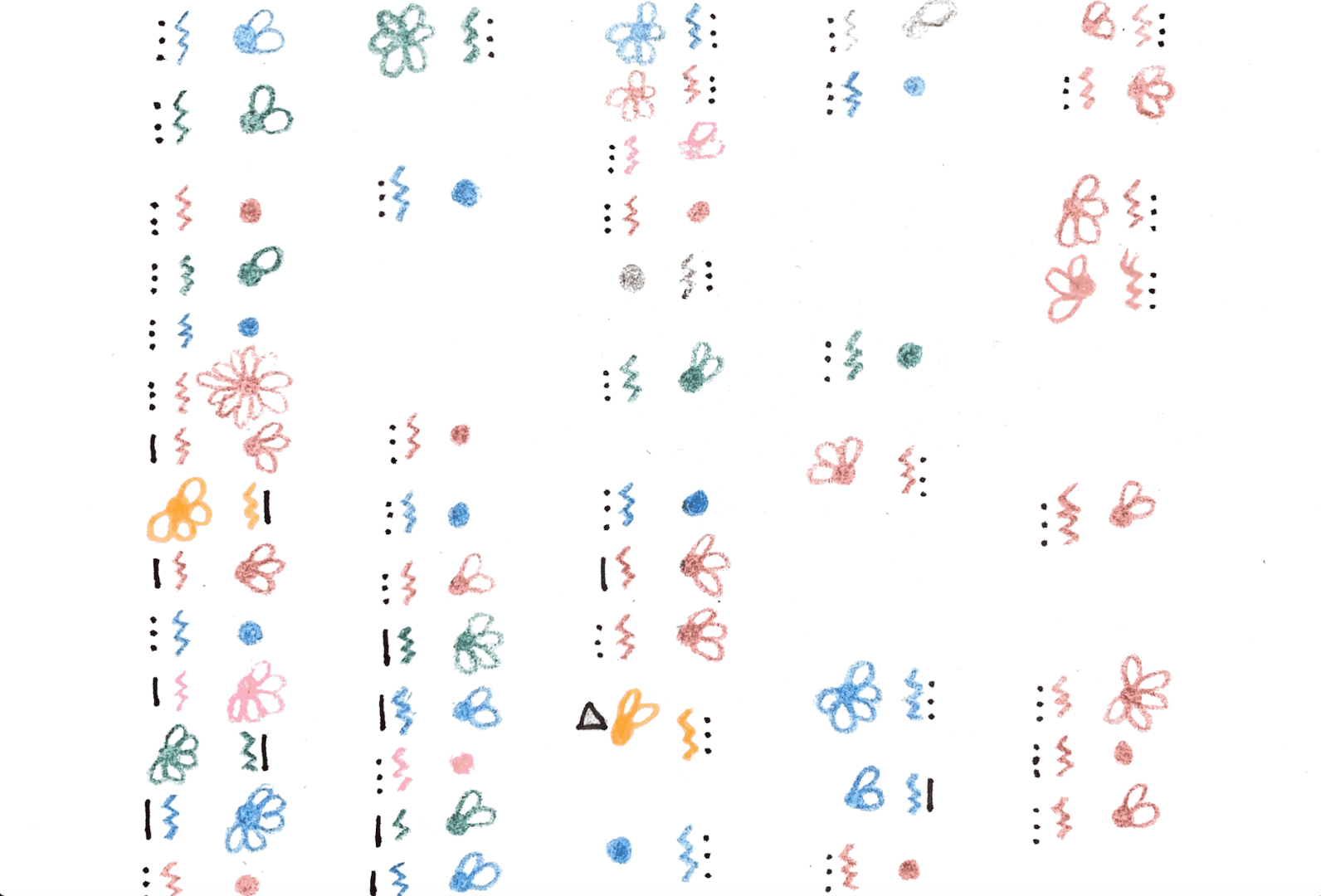
This past week, I collected data from my Instagram usage. I tracked the amount of time I was on the app, whether I engaged with Instagram stories or the feed first, what type of content I engaged with (if any) and how many of my friends’ stories I looked at. I used a flower design with colors and shapes to make up the legend.

(Apologies for the lighter colored pencils that did not show up in the scan as clear as the others!)

History of Data Visualization

From medieval to modern times, there is an extensive intellectual history of data visualization. The Milestones Project was used to collect and organize important developments from a range of areas and fields that influenced the creation and evolution of data visualization (Friendly, 2006). 

The earliest roots of data visualization begin with map-making and visual depictions. The 19th century was most likely the earlies time of statistical thinking and data collection in relation to planning (cities, buildings) and commerce. The historical documentations in fields like probability, statistics, astronomy and cartography align with the developments over time with data visualization. 

Epochs – a period of time in history or a person’s life, typically one marked by notable events or particular characteristics (the Victorian epoch)

Friendly provides a graphic overview of milestones in different epochs throughout history. Starting with the 1500s and moving forward, Friendly examines a graph that shows the milestones of data visualization in history. The earliest moments of visualization came before the 1700s with star maps and geometric diagrams. Egyptians laid out city structures in grid maps and would be reference tools for other civilizations until the 14th century. 

By the 16th century, geographic and position visualizations were well-developed. One of the most important and sophisticated developments during this time was triangulation, which pin-pointed locations. 

Towards the end of the 18th century, more detailed cartography came to fruition. Mapping of geologic, economic and medical data was attempted in visualized forms. William Playfair (1759-1823) is considered to be the inventor of many data visualization forms used today – the line graph, the bar chart and later, the pie chart. In 1833, Andre-Michel Guerry used the Ministry of Justice in France’s centralized system of crime reporting to produce work on the moral statistics of France. His work was said to be the first foundation of modern social science (Friendly, 2006).

We’ve seen throughout history that data visualization was used in so many forms and fields of study. In 1831, the first case of Asiatic cholera was reported, but the water-born cause of the disease would not be discovered until 1855 when Dr. John Snow made his famous dot map. By the mid-1800s, the need and understanding for numerical information and visualization was soaring in Europe, as people began to realize the importance for social planning, industrialization and transportation. The Age of Enthusiasm transformed into the Golden Age, which was known for its beauty and innovation in visualization (Friendly, 2006). 

Francis Galton had major contributions in the history of data visualization. He developed ideas of correlation and regression in graphs. In 1881, he created a “isochronic chart” that showed how much time it would take to travel anywhere in the world from London. His most notable graphical discovery was the anti-cyclonic pattern of winds in low-pressure regions (Friendly, 2006).

After the “golden age” of the 1800s, the “modern dark ages” of visualization came in the 1900s. The rise of data visualization fell off throughout the 1900s and there were few graphical revolutions until the 1950s. 

In the last quarter of the 20th century, data visualization transformed into a vibrant, extensive research area. Software tools for a wide range of uses were implemented for desktop computers. Friendly explains that it is now more difficult to track and highlight the recent updates to data visualization’s history because it is now so vast and expansive and happening at a quicker pace. 

Friendly’s Milestones: Places of development chart was interesting to examine. He explained how Europe was the leader in data visualization in the early history, but it is interesting to see the immense spike that happened in North America, which left Europe behind. Even in the 2000s, Europe is behind North America in relative density. 

Final Thoughts from Friendly

From Friendly’s broad view of the history of data visualization, he summarizes with the idea that the modernizations of data visualization came from practical goals and the need to understand relationships and correlations in new ways. The transformations of statistical research and resources helped move the history of data visualization to where it is today. 

Pros and Cons of technological advances in data visualization 

Throughout history, we have seen the transformation of data visualization happen over time. With technological advancements, data visualization has become increasingly sophisticated. For example, with the current COVID-19 pandemic happening, new information is available almost every day from around the world. We can chart the trends of the virus, number of deaths, number of cases and share it with the public. Information is available to be processes and charted quickly, so information is spreading as fast as the virus itself. Back in the early periods of documenting data visualization, this was not possible. 

In addition, with the advancements in data visualizations, people are able to predict correlations based on history. Using trends in data visuals can be super helpful in medical case studies and in real life situations. 

Cons of data visualization do exist as well. Sometimes, viewers can have too much information. A lot of colors, numbers, statistics and geometric figures can be confusing for viewers. This is called visual noise (Gorodov & Gubarev, 2013).

What Makes an Effective Chart?

In my opinion, a good chart is easy to read, follow and understand. It doesn’t take long for the viewer to understand the flow of information in a good chart, and the viewer is able to understand specific themes and trends after seeing the chart. 

When I look at a chart, I strongly respond to data visuals that are appealing to the eye and easy-to-follow. If there is a lot going on, and if the chart is labeled poorly, I won’t look at the chart for a long time. This is especially true if I am looking at a chart with information I don’t know a lot about. If I do know more about the subject, I can usually interpret the chart without too much difficulty. But, if the information is new to me, then a detailed key and easy-to-follow flow is better for me as a viewer. 

Here are a few examples of “good” charts and data visuals, in my opinion. 

Sarah Bartlett’s “Say What? A Brief History of Profanity in Hip Hop” was a very interesting set of data visuals. 

The chart labeled “Which City Swears the Most?” was really easy to understand and engaging at the same time. The circles on the cities represented the average number of swear words per city in hip hop music. The bigger the circle, the higher number of swear words. Bartlett’s entire data report on the history of profanity in hip hop was really cool. I thought her color scheme was clean and her visuals were all unique and engaging. 

Credit: Sarah Bartlett (2019)

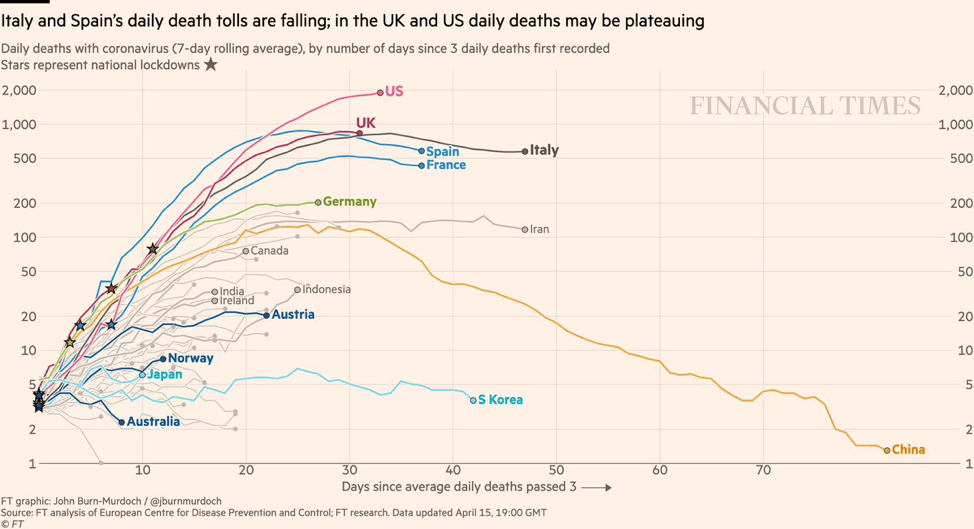
I also enjoy viewing the classic line graph with the x and y axis. This chart from Financial Times shows the death tolls from COVID-19 in numerous countries around the world and how they have risen or fallen since the time when three daily deaths were recorded. This chart is easy to read with the x axis showing the number of days passed and the y axis represents daily deaths. The colored lines lead the eye across the graph and show the increase or decreases of deaths in each country. 

Financial Times

This third chart is also from the Financial Times. I found their COVID-19 home base to be very interesting, educational and easy to read. The chart shows the surges of global daily deaths from COVID-19 and which countries have held the highest number of average daily deaths. At the beginning of the pandemic, Europe and the United Kingdom were in the epicenter and accounted for a majority of daily deaths, which is shown by the large blue wave on the left side of the chart. The timeline extends to July 9, and now, Latin America has taken over and accounts for 49 percent of the average global deaths, with Brazil leading the way. The U.S.’s share of average daily deaths has fallen to 12 percent. 

Financial Times

Another interesting aspect to this chart is the major difference between the sizes at the beginning and end of the chart. The ends represent the average daily deaths across the world. The left side, which represents the beginning of the pandemic, shows the small number of 393 daily deaths. The right side grew immensely and now the average daily death number is 4,731 with Brazil at the forefront. 

These charts are all different in their own ways, but they all accomplish the same goal – giving the viewer information in an easy-to-follow way. There is an ample amount of information that is being received by the viewer, which is also a good quality for a chart.

References

Bartlett, S. (2019). Say What? A brief history of profanity in hip pop. Retrieved from https://public.tableau.com/profile/sarah.bartlett#!/vizhome/SayWhatABriefHistoryofProfanityinHipHop/SayWhat

Gorodov, E. & Gubarev, V. (26 Nov., 2013) Analytical Review of Data Visualization Methods in Application to Big Data. Retrieved from https://www.hindawi.com/journals/jece/2013/969458/

Friendly, M. (21, March 2006). A Brief History of Data Visualization.

FT Team. (10, July 2020). Corona virus tracked: the latest figures as countries start to reopen. Retrieved from https://www.ft.com/content/a26fbf7e-48f8-11ea-aeb3-955839e06441

The Final Buzzer

Seven weeks came and went. One project with a goal of helping collegiate student-athletes was completed. Ideas and information were developed and polished and a booklet was created. 

I learned a lot through this process. The idea of the booklet at the beginning was so different from the final product I made in the end, which taught me a great lesson. Most of the time, the idea we have in our head when it comes to a project, a plan, a goal or even a job ends up being completely different than we what we expected. That’s part of the process and how we grow as individuals and professionals. 

The first draft will not look anything like the final draft, and sometimes the smallest turn of inspiration helps lead you to where you need to go and takes you down a path you hadn’t thought of before. 

I learned about a few cool tools that helped me create my booklet and take it to a different level. Unsplash is a free website where artists and photographers share their photos with the world. There are millions of photos on this site that are high quality and free! The Noun Project is also another great tool that provides free icons to users to use with just minimum attribution. 

Within this process, I also learned more about the printing process for books/magazines/booklets. InDesign has a feature that is really cool for printing booklets. You are able to take your InDesign pages that you have designed (probably ordered numerically) and then InDesign reformats a booklet PDF file with your pages imposed This means that your new PDF file will have the pages ready for print – page one is with the very last page, page 2 is paired with the second-to-last-page, etc. 

This was a complicated process for me to figure out. I didn’t think about the process printing until the end of the project. In the end, I ended up printing my booklet on 8.5 x 11 sized paper but with two pages of the booklet printed on one single piece of paper. So, when the pages print, the first page needs to print with the last page because the paper is folded to create the booklet. It was a little difficult to figure out (Shoutout to YouTube) but in the end, I was happy with the final product. 

Over the last couple of weeks, I have also reflected on my job, college sports and how they are going to change over the next few months and years. With help from some of my athletes at Quinnipiac, I discovered what they view the name, image and likeness ruling as and how they intend to use it. For the most part, the athletes that I talked to would not want the distraction of having a separate side hustle while playing a Division I sport. Individually, the players don’t have a desire to make money and would rather focus on their sport and school. And honestly, with those two things alone, collegiate athletes really don’t have extra time in general. 

With that said, I’ve researched about the name, image and likeness ruling for the past seven weeks and know a lot about it now. But, I’ve concluded that with the introduction of the rulings next fall, I don’t foresee a lot of athletes getting involved in outside sponsorships right away. I truly think that these rules will only affect a small number of athletes in the NCAA – the Zion Williamsons of collegiate athletics. The athletes that have the potential to make hundreds of thousands of dollars. 

Now, this doesn’t mean that athletes who don’t have as big of a marketability won’t try to make money; they definitely will. But, I think for the amount of debate that this issue has brought to the NCAA, conferences and media, the end result won’t have a dramatic effect right away. 

Five years from now, however, the landscape of college sports could look very different. With any type of new ruling or legislation, it will take time to see how it will truly fit into the world.  

In my opinion, the heated and drawn-out debates about whether to implement this ruling or not was much more dramatic and visible than the actual application will be. I think this is due to the confusing nature that the NCAA guardrails will hold and how student-athletes are able to interpret them. 

In addition, every student-athlete will have a different situation. Permissibility will be determined on a case-by-case basis. 

So, if the Student-Athlete Toolkit on Name, Image and Likeness helps student-athletes understand what opportunities they have and the best ways to go about taking advantage of those opportunities, then that will be a success in my book. 

Student-Athlete Toolkit on Name, Image & Likeness

Student-Athlete Toolkit on Name, Image & Likeness: The Process

Over the course of a seven-week period, I created a toolkit for NCAA student-athletes on the evolving rules related to name, image and likeness. The toolkit was designed in the form of a booklet with information about student-athletes’ new opportunities to use their name, image and likeness to earn compensation – something that was previously impermissible for NCAA student-athletes to do under amateurism rules. 

From my experience working with student-athletes over the last three years, I have discovered that they don’t know a lot about what is and isn’t allowed as a student-athlete when it comes to social media. The goal of this booklet was to help student-athletes understand the opportunities they have once the new legislation goes into action in the fall of 2021. 

You will find the steps to my process below, along with links to blog posts from the past seven weeks and photos taken through the process. 

Student-Athlete Toolkit Project Proposal 

Blog: Project Management PlanMay 31, 2020

The proposal for my project was the skeleton for the end product. I outlined my ideas alongside the problem statement and added the information that needed to be included in the booklet. The proposal included my goal, which was to provide student-athletes a toolkit for when their opportunity to earn compensation off their name, image and likeness came into being. 

I laid out the essential information that was going to be included, and I planned the artifacts that were going to help me add key information for the booklet that I may not have found through research. 

Here are a few parts of my proposal. 

I then broke down the specific questions that I, as the researcher and creator, would need to answer for the readers. I wrote out what my plan was going to entail: research, design & execution.

Research/Planning

Bibliography

In order to create a toolkit for student-athletes, I had to research about name, image and likeness. Working in college athletics and being a former student-athlete helped me to have general knowledge of the current restriction’s student-athletes have and what is being discussed to change. But, I needed to find out more and really breakdown what the new rules could look like in a language that is easier to understand than what the NCAA publishes. 

In addition, I used Notion to consolidate my plans and outline what I needed to do each week to finish the project. 

Artifacts 

Artifacts Blog: What is the Real Scandal Here?June 7, 2020

In order to gather more information about what student-athletes know about name, image and likeness, I went straight to the source. I interviewed four Quinnipiac student-athletes on a Zoom call and asked them about the old and new rules about name, image and likeness. The information they provided was very insightful and helped me design the information even more specifically for the toolkit. (I kept their names and images private for confidentiality.)

My first draft of the booklet was basic. It included the final copy that I knew needed to be in the booklet to provide student-athletes with enough information. But, the design aspect needed some tweaking. After rethinking the design, I changed the layout drastically and found inspiration from other sources that really helped me in the end. 

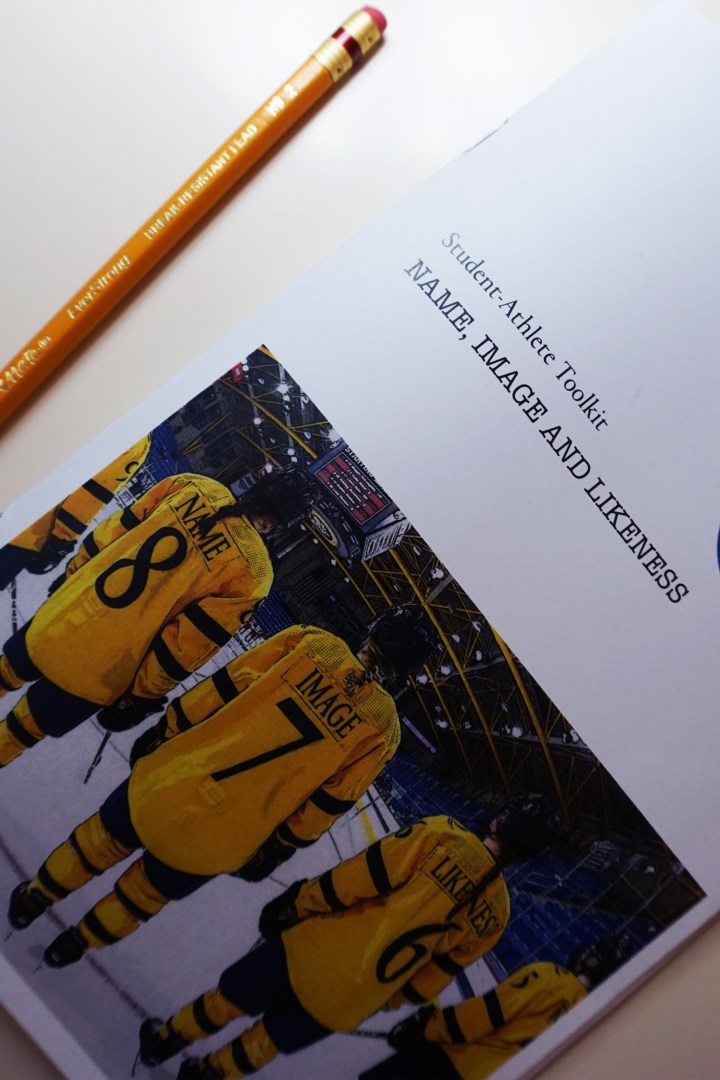
Cover 1 (left) | Final Cover (right)

In addition, a grid layout was used in the final draft. This created more of a magazine look-and-feel to the booklet.

Printing Process 

Blog 7 – July 2, 2020

After revising my first draft and completing the final draft, I then moved on to the printing process. I quickly realized that in order to print my booklet, I would need to become familiar with the InDesign feature called Print Booklet and the process of imposition. Imposition is the process of reordering your pages so that the first and last page are printed on the same sheet of paper. This took some time to organize, but I figured out that InDesign can create a PostScript File, which imposes a booklet for you. 

Basic Imposition Process

Student-Athlete Toolkit on Name, Image & Likeness 

Final Product

My final booklet came out to be 24 pages (12 sheets of paper). I printed the booklet on 8.5×11 paper with a 2-up Saddle Stitch. 

I believe my booklet is a great starting point for this evolving landscape in college athletics. I plan to add information as it released to the public over the next few months as the NCAA Board of Governors continues to vote on different aspects of the legislation.   

You can see a PDF version of my booklet HERE:

The Fourth Quarter

Growing up, I was always taught that too much white space is a bad thing. You had to fill the entire page in school to show that you were writing enough and had enough information. In design or blank space, white space is your best friend, and I forgot that.  

The past couple of weeks have been difficult. I lost a lot of my creative energy and found it hard to complete the assignments for my graduate school class. But, after some Google searching and a meeting with my professor, I felt refreshed. I was ready to redesign my Toolkit for NCAA student-athletes about their name, image and likeness and have all of the white space that I needed.

Pages 4-5 in Student-Athlete Toolkit on Name, Image & Likeness

I discovered a photo sharing website called Unsplash, which is a photo gallery community where photographers share their high-resolution pictures and anyone can download them and use them for free. This website is home to over one million beautiful photos and really helped me with my redesign. 

My professor also helped recalled information that I learned in my undergraduate time in my newspaper, yearbook and publishing classes. The grid structure of Adobe InDesign helps create a uniform look and feel for the document. I went with a three-column structure for my copy and photos throughout the toolkit. This also helped my mind become less cluttered and unorganized by giving myself something more to work with.

Adobe InDesign
Grid Structure from Thinking With Type

The purpose of this toolkit is to help student-athletes understand the potential gain and the dissect the vague restrictions behind the NCAA’s name, image and likeness ruling. Now more than ever before, social media will be a student-athlete’s best tool to use once the collegiate athletics world merges with the $5-10 billion influencer business. (Planos, 2020).

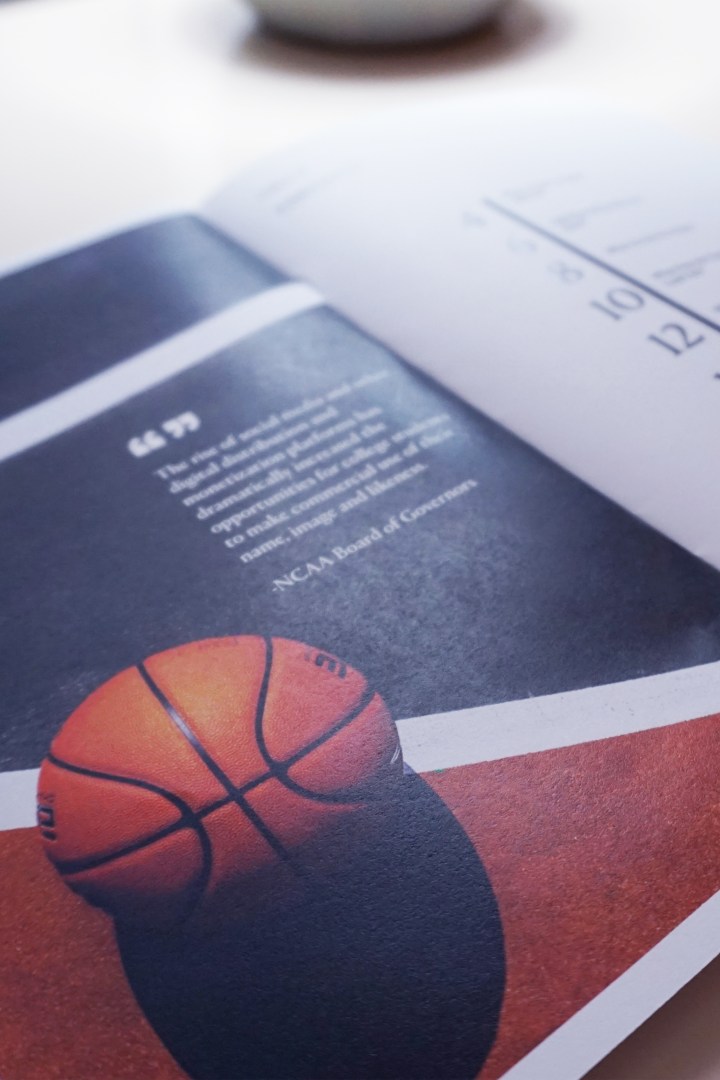
Social and digital media played a significant role in these proposed changes, according to the NCAA Board of Governors’ meeting report from April 17.

“The rise of social media and other digital distribution and monetization platforms has dramatically increased the opportunities for college students to make commercial use of their NIL.”

NCAA Board of Governors meeting | April 17, 2020

And it looks like the NCAA is truly trying to make this all happen, but with their own guardrails. The NCAA has stated in their initial decision to move forward with compensation rules that endorsements student-athletes can receive will be independent of athletic activity and not an endorsement payment for athletic activity. The NCAA says there will be regulations on third-parties or agents, but they do not provide any further details (Sallee & Silverstein, 2020).

Conferences are trying to push for this to happen, too. The Power Five conferences spent $350,000 on lobbyists to attempt to influence Congress on legislation allowing collegiate student-athletes to earn endorsement money, which was more than they have previously spent in any full year. The Southeastern Conference spent the most out of any conference – $140,000 (Nuckols, 2020). 

“We look forward to a constructive exchange of ideas about ways we can further enhance our student-athletes’ educational and athletic experiences while ensuring that any future changes can be administered fairly on a national level.”

Greg Sankey, SEC Commissioner

According to Nuckols, the SEC has never employed Washington lobbyists and left the work for influencing Congress to the universities and the NCAA until now.

And as we could have predicted, student-athletes are involved in the legislation process, as well. Current and former collegiate student-athletes across the country are a part of the working group with the NCAA that will help provide information and experiences related to earning money for their name, image and likeness during the time when that was impermissible. 

“We’re the solutions group,” Jaila Tolber, former student-athlete at Virginia Tech said about joining the working group. “So, coming up with some kind of framework is going to be a huge part of our plan. My goals are to make those recommendations that align with the NCAA principles and allow student-athletes to benefit from their name, image and likeness. Having that same access that regular students have. 

Looks like there are a lot of people in this process who have student-athletes’ best intentions at heart. Let’s keep the momentum going forward.

Name, Image…Income Tax?

On April 29, 2020, the NCAA Board of Governors supported rules changes to allow student-athletes to have opportunities to receive compensation for third-party endorsements. And on July 1, 2021, the NCAA finally approved and finalized the ruling and for the first time in history, collegiate student-athletes are allowed to earn compensation on their own name, image and likeness deals.

Student-athletes have many opportunities to earn compensation, if they so choose. For many of the bigger and more valuable deals, student-athletes will need to look into having an agent or third party involved in this operation. It will be difficult for student-athletes to negotiate deals with businesses, sponsors and other entities without having any experience in this type of business. 

In addition, compliance offices are now busier than ever trying to manage the influx of questions about NIL ahead of the 2021-22 academic year. It will be important for student-athletes to know that compliance offices will have some answers, but not all. University employees won’t be able to help student-athletes negotiate deals or help find opportunities; the compliance office can only regulate per the NCAA’s evolving ruling. 

Male and female athletes will have the same rules, guardrails and regulations provided by the NCAA. Everyone will be on the same playing field and level. Student-athletes will all have the general opportunity to earn compensation for their name, image and likeness, but the number and value of opportunities will vary immensely. There are many factors involved with how and why student-athletes could receive more money than others. 

I conducted an ample amount of research in June of 2020, and I realized that there will not be a general framework for student-athletes to follow. There is not a model that can be replicated for each athlete’s situation. Every athlete’s situation and opportunity for compensation will be different. 

The NCAA has a tall task ahead. I do believe the implementation of these new rules is moving the collegiate athletic experience in the right direction, but there will be a lot learning along the way. In addition, the NCAA has not had the reputation for “sticking to their guns”.

“For decades, the NCAA and its members considered cost-of-attendance stipends anathema to amateurism. And then they didn’t. That pretty much describes the NCAA attitude toward amateurism throughout its 115-year history.” (Maisel, 2020).

Student-athletes have already shown what the power of social media brings to the table. The name, image and likeness ruling will help out student-athletes who have major numbers in followers but don’t go to a Power Five school.

“For example, Phoenix Sproles is a wide receiver at North Dakota State University and has 147 thousand followers on Instagram and Tik Tok, which is by definition an “influencer/star status” (Cousin, 2020).

The power lies with the student-athletes. The problems come as the NCAA will attempt to regulate the opportunities to comply with Title IX rules and keep things fair, which isn’t totally a bad thing. It will just be difficult. 

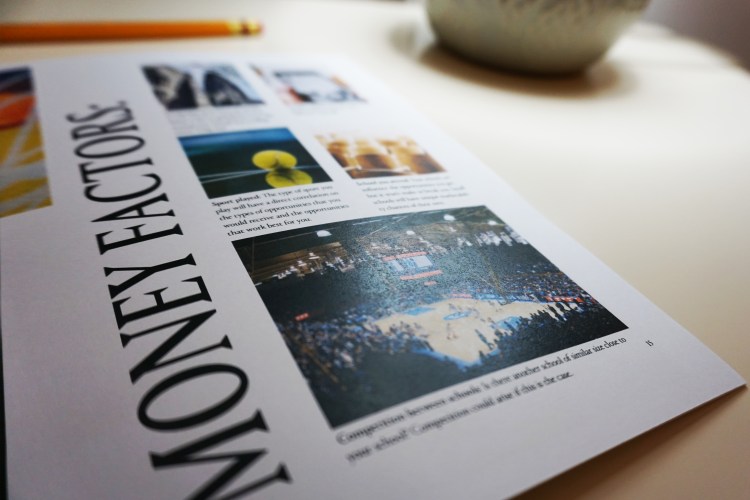
There are so many factors that go into student-athletes compensation opportunities:

-Institution

-Sport played

-Social media followers

-Geographical location of school 

-Competition with other schools 

Let’s not forget that student-athletes will have to file taxes on the money they earn.

“We have discussed the impact of name, image and likeness in our director’s meeting, but we didn’t even think about the tax implications,” said Jeff Pritsker, Assistant Athletic Director for Business and Administration at San Jose State University (Davis, 2020).

An example of how this would work with student-athletes includes a student-athlete receiving a car from a dealership for a year after appearing in commercials. As with any normal taxpayer, a return must be filed if a student-athlete makes $400 from self-employment. 

This will also get messy when a student-athlete is from one state, but attends a school in a different state. 

“For example, a student-athlete from a high school in Georgia (which has a state income tax) enrolls at a university in Florida (which does not) and plays for the football team. He receives free meals from a restaurant in Florida in exchange for endorsing the business. If the athlete is still considered a Georgia resident by that state’s laws, the benefit is considered income subject to Georgia’s state income tax even though the activity took place in Florida” (Davis, 2020).

This is going to get crazy.

Amateurism Transition

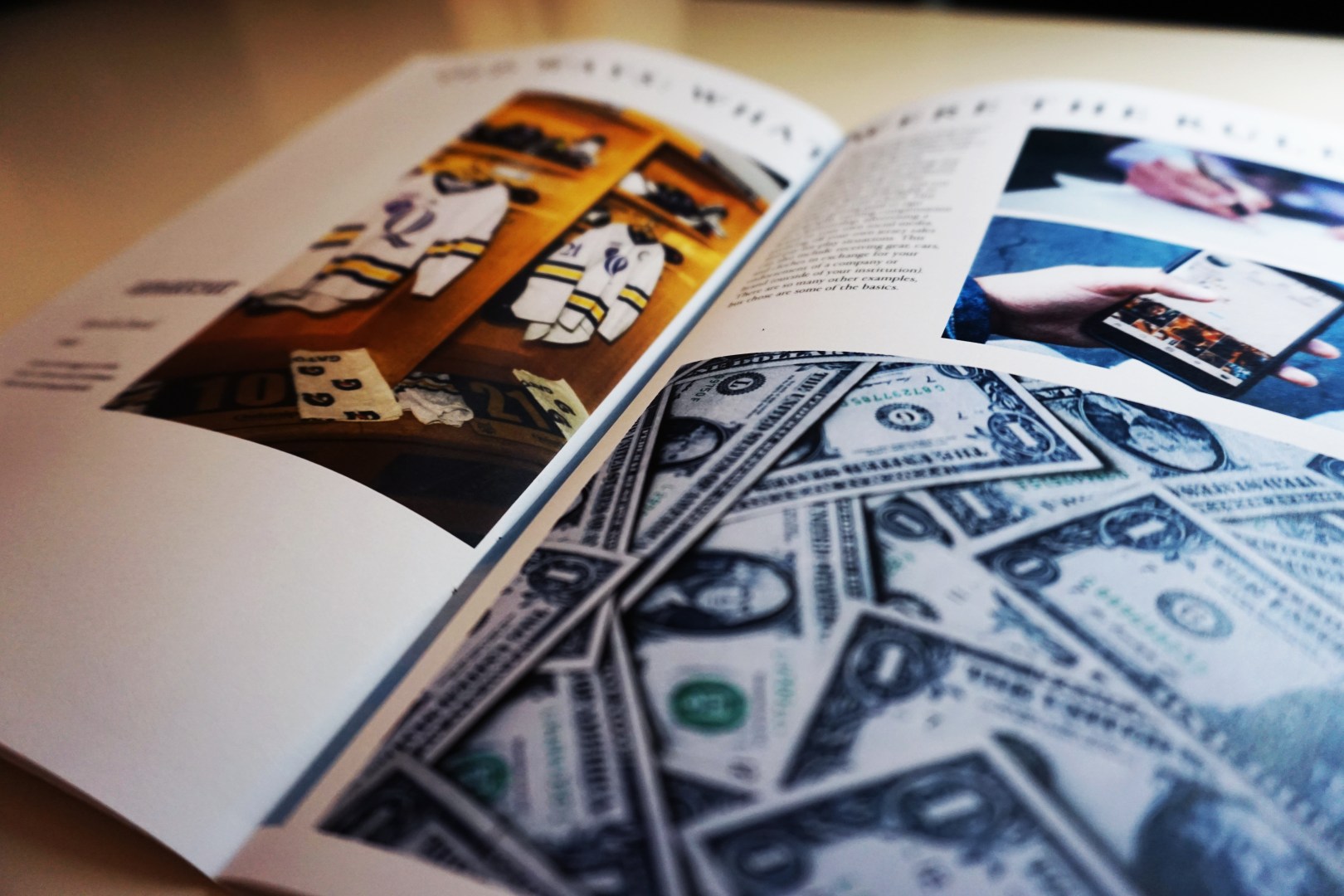
The NCAA has had a long history of maintaining amateurism rules in the realm of collegiate sports. Because collegiate student-athletes are amateurs, up until July 1, 2021, you were not allowed to be compensated for anything that involved your name, image and likeness. Earning compensation would throw you into the “professional” category and you would be deemed ineligible to compete for your school. This includes get paid to sign autographs, earning compensation for a sponsorship, advertising a brand on your own social media, profiting off your own jersey sales and pay-for-play situations. There are so many other examples, but those are some basics.

In January 2021, the NCAA Board of Governors voted on the name, image and likeness ruling that has been in debate for a few years now, and, after months of debating, student-athletes now have the opportunity to get paid for outside endorsements and compensated for name, image and likeness qualities. 

Back in the summer of 2020, I was able to talk to a few of the student-athletes I work with every day about NIL. It was interesting to hear what student-athletes did and did not know about related to the debate. Their understanding of name, image and likeness rules in relation to social media, outside companies and brands was basic. In the past, the student-athletes report to their coaches, compliance officers or athletic communication directors when they have question about an NCAA rule. In a lot of cases, those administrative positions sometimes don’t have all of the answers either. 

Basically, the NCAA’s rules don’t have all of the answers because the lifestyles of collegiate student-athletes have changed immensely, so the rules don’t always align to what is going on, especially in the social media world.

So, when the new ruling was voted on and successfully implemented for the 2021-22 academic year, people wondered how will student-athletes know what their opportunities are? The universities and institutions won’t be allowed to take any part in the student-athletes’ business relations.

Jill Bodensteiner, the director of athletics at St. Joseph’s and member of the NIL Committee, mentions student-athletes having the opportunity to take classes like sports management, marketing and digital storytelling at their schools (Rueb, 2020). That would be great, but, what if you have a student-athlete who has a heavy course load in, for example, a pre-med track and can’t afford to take one of those classes?

We also can assume that this process won’t be a free-for-all right from the get-go. These rules will have to be slowly implements and then examined after they are live. Things will be adjusted and changed over the course of the first couple of years. The NCAA also left up a lot to interpret in the opening legislation. 

“… If you couple the name, image and likeness to a (proposed) one-time transfer, what’s to say that the University of Alabama likes my player and they come to him and approach him on a side deal? ‘Listen, come here, we’ve got this car dealer that’s going to pay you $50,000 a year to advertise for them and you’ve got an opportunity to win a national championship and you can play right now.’ That’s more like the wild, wild west in my opinion.”

Louisville head football coach Scott Satterfield

The rules the NCAA will create must be air-tight when it comes to recruiting. The goals of this new legislation are not to really change the landscape of recruiting that dramatically, and without strict rules, it very well could. 

Student-athletes should have resources that can help them through this process if they so choose. If you are a student-athlete, you must keep in mind that there are only a small number of athletes that could earn life-changing money. For student-athletes with smaller followings, the money they could earn is not substantial. 

This chart displays estimated profits for student-athletes with different social media followings and sports played.

I think student-athletes will find that the work that would need to go into earning compensation and advertising for brands is not worth the return. In my Zoom interview with five student-athletes I work with, all of them mentioned not being involved in searching for money-making opportunities during their playing seasons. They all said it would be a distraction during competition season, and they mentioned it could cause drama within the teams. 

But, that does not mean they shouldn’t be educated on what their opportunities could look like. Breaking down the rules, what they were and how they changed, will help student-athletes know and what to expect as they progress through their time as a student-athlete. For some, this time of playing for an educational institution would be the closest thing they could have to playing professionally, as well, especially for female student-athletes. 


Why not try and earn some extra money?


Burn It to the Ground

Now, before you think into that headline too much, just keep reading.

I’ve been trying to write this for a while now. I have had so many ideas and ways I wanted to write about this, but I knew I needed to centralize my thoughts and not just go on a rant. There is a revolution happening and now is not the time to be silent. 

In April 2016, Beyoncé released one of the most influential albums of the decade, if not ever. And to be quite honest, I am not sure how many of my white friends could name even one song from it…

Lemonade is a beautifully soul-crushing album that tells the stories of Beyoncé’s upbringing and relationship with her father, her marriage, her fears of forgiveness and finishes with two immensely powerful songs about race, social injustice and police brutality in America. 

Freedom” is a rallying cry about the hundreds of years of oppression that the Black community, specifically Black women, has endured.

Freedom
Freedom
I can’t move
Freedom, cut me loose
Freedom
Freedom 
Where are you?
‘Cause I need freedom, too
I break chains all by myself
Won’t let my freedom rot in hell
Hey! I’ma keep running
‘Cause a winner don’t quit on themselves

I’ma wade, I’ma wave through the waters
Tell the tide, “Don’t move”
I’ma riot, I’ma riot through your borders
Call me bulletproof

Lord forgive me, I’ve been runnin’
Runnin’ blind in truth
I’ma wade, I’ma wave through your shallow love
Tell the deep I’m new

I’m telling these tears, go and fall away, fall away
May the last one burn into flames

I mean if that doesn’t give you chills just reading it… go listen to it. And I didn’t even get to Kendrick Lamar’s verse. 

I wanted to write about this song because of the timeless power that the words hold, and because I don’t think many white people have heard it. Beyoncé released this in 2016. Four year later, and the words are still so relevant. She pleas for freedom, asking where it is. Where has it been… 

She warns that she will wade through the waters… the waters of our world, our society. In the ocean, the tides control the waters’ direction, flow and movement. The tide’s control could be interpreted as a symbol for the government and specifically, the system of law enforcement and police in our society. The government controls where we emblematically move as groups and individuals. The police imposes that movement, directing the climate of ease, or in the Black communities, a climate without ease. No feeling of safety or alliance with the police, only fear. 

Beyoncé calls for a riot as the tides eventually change and bring a storm. Later, she sings that her tears will “fall away, fall away, and may the last one burn into flames.” 

Flames. Smoke. Shallow Love. Burning down.

Why are people surprised of the destruction, rioting and looting that has come after the murder of George Floyd? 

I knew white boys in school that would punch a hole in the wall because they lost a beer pong game. And you’re mad that people, who have lived in a cold fear of being murdered while getting pulled over for a traffic violation, going on a jog or walking down the street because of the color of their skin, f****d up a Target?! 

White people who have not been able to understand this have to open their eyes, or at least listen to Kimberly Latrice Jones preach about the unjust, unfair and broken system Black people have lived in since they were forced to come 400 years ago. The poverty gap between poor Black people and the rest of the world is so vast and expansive that looters have become very present at these riots because they have nothing else. It makes sense. The system is broken and the Black communities living in poverty are set up to fail because the system has not evolved. 

Wanting to burn down the entire system and everything it represents is reasonable in relation to the centuries of oppression, hatred and violent racism that Black people have endured. We should count ourselves lucky that “black people are looking for equality and not revenge.”

So why not (symbolically) burn the system to the ground?

Through this revolution, we have witnessed that there is no correct way to protest. You’re not going to make every party happy, even if it’s peaceful. Up until George Floyd’s death, no one was listening.

This brings me to Colin Kaepernick. *sigh* Let me collect myself. 

Drew Brees has proven that we have so much work to do. That man was absolutely shredded on television and social media, and we aren’t even 100% sure if understood what he was saying even after the third apology. I really hope finally understood and that his PR team didn’t just walk him through all of those responses. But, who knows. 

All I know is that Kaepernick was right. All along. I watched people virtually scream in agreement when Trump called him a son of b**** and to get off the football field – all for a peaceful protest about an issue none of Trump’s followers or the others cared to know about or had the human decency to empathize with. 

The people (Trump, the NFL) who didn’t understand saw a wealthy Black athlete disrupting the season-ticket holders’ Sunday afternoons with politics” …

So, they banned him – dropped him so fast that Laura Ingraham didn’t even have time to tell him to shut up and throw the football.  

When I saw Kaepernick kneel, the first image I thought of was when Tommie Smith and John Carlos each raised a fist in the air during their medal ceremonies at the Olympic Games in Mexico City. People were outraged at the time – the International Olympic Committee banned and suspended Smith and Carlos for their protest. 

That was in 1968. Fifty-two years ago.  

Kaepernick’s kneel, which he explained multiple times, gave the silenced police brutality issues in America a voice, but only to people who wanted to hear and wanted to listen. White people who didn’t agree with Kaepernick’s protest were blindfolded by the same flag that has kept them free and without fear of harm due to the color of their skin for their entire lives.

To people who thought their white grandfathers were the only ones who fought in wars of America’s past, Kaepernick’s kneel disrespected the flag, which they claim symbolizes freedom for all – the American Dream. But how can a flag that is supposed to represent the freedom for all of a country’s people have an equivalent meaning to someone who has never had the same freedoms as their white counterparts?

Freedom, freedom where are you?

Cause I need freedom too…

Can you not hear their cries? It was never about the flag. It’s about the systemic racism that has grown and weaved its way through years of history, despite white people thinking everyone is treated “equally” and that slavery was “abolished”. There has never been equality for all. The American Dream has yet to come true…

I recently looked into the reversal of the Great Migration. From 1910 to 1970, about 6 million Black Americans departed from the South for other parts of the country. This massive distribution of people was named the Great Migration. They left the South to look for jobs in the Midwest, West and Northeast, and to escape the lingering caste system of the racism in the South, which included the beginnings of the Jim Crow laws and sparse economic opportunities.

The U.S. Census Bureau claims that the reversal of the Great Migration began as soon as the first wave ended. From 1975 to 1980, the South gained more than 100,000 Black Americans after losing 250,000 from 1965 to 1970. This reversal was ignited as people began to look for post-recession economic opportunity, especially in the early 2000s. 

But, what got me was that Black people in the Northeast moved back to the South in the 1970s and 80s because there was also a push from the North, both in terms of the economy and in terms of racial relations,” William Frey, author of Diversity Explosion: How New Radical Demographics Are Remaking America.

We keep pushing Black people out. Back and forth they went looking for homes, places of refuge and safety. Refuge in their home country. We’ve covered our eyes and ears to their cries for help. 

We’ve turned our backs to the systematically-structured Black communities in poverty just minutes away from our suburbs. 

We’ve silenced those who have peacefully spoken out in protest. 

We have to stop. Enough is enough.

I think the Earth and God realized this. The COVID-19 pandemic was the beginning phase of a universal TIMEOUT. Not a 30 second, not a 1 minute…an extended time of self-reflection and essential national change.

The Earth locked us in our homes, stole the key and said “Y’all I need a minute.” 

And God said, “Figure. It. Out.”

We cannot take this time for granted. We have to keep working. Everything on social media that explains the Revolution, emphasizes someone’s story, lists ways to help, gives links to donate and directs people to sign petitions is all awesome. But, the hard work will be done backstage when no one is watching. It won’t be something you can post in your Instagram story or take a picture of, but the hard work will be moving the Black Lives Matter movement in the direction it needs to go. 

George Floyd, Ahmaud Arbery, Treyvon Martin, Michael Brown, Tamir Rice, Sandra Bland, Philando Castile, Walter Scott, Beonna Taylor and so many others’ stories are so much more than a hashtag. Say their names. Explain their stories. Know the facts. Scream for justice. Breonna Taylor’s killers have not been arrested. We have to keep going.

Wave goodbye to the normal you knew before March 12th, because it is never coming back. The Black Lives Matter movement sparked the overdue Revolution, and if you aren’t with us, get out of the way.

I wrote about this because Black Lives Matter, and being silent or neutral is siding with the oppression. I know my white privilege and know the work I have to do as an individual. I posted this because if these words can move someone enough to Google something they didn’t know about or change a heart, then that will be a new step on the right path – an additional anti-racist fist raised in the air. 

The last tweet I looked at that Donald Trump tweeted had 56,000 favorites and 16,000 retweets in 36 minutes. We have work to do people. 

“If you surrender to the air, you can ride it.” -Toni Morrison

What is the Real Scandal Here?

In 2019, college football and basketball coaches were categorized as the highest-paid public employees in 40 states (Hruby, 2020). According to USA Today, Nick Saban, Ed Orgeron and Dabo Swinney are the three highest paid coaches in college football. Together, their earning top 26.5 million dollars.

Up until July 1, 2021, the student-athletes who are physically doing the hard work, were not allowed to earn compensation on their own name, image and likeness. 

Illustration by James Clapham – The Washington Post

The ruling went back-and-forth between the federal government, individual state’s governments and the NCAA. Not to mention, the fans who have no stake in the game whatsoever, had plenty to say.

There has been a very distinct split of people for and against this new name, image and likeness ruling. Despite coaches getting paid the big bucks, student-athletes did not get a chance to receive anything more than the value of their scholarships and a little cost-of-living change (Hruby, 2020). 

One side says…student-athletes are already spoiled and don’t deserve to make more. They don’t recognize the worth of their scholarships. 

On the other hand, there are those who agree with Pulitzer-Prize winning civil rights historian Taylor Branch who argued that NCAA amateurism was vastly unjust. 

“…a bill attainder, stripping from college athletes the rights of American citizenship.” -Taylor Brand in “The Shame of College Sports” from The Atlantic

Over the course of 15 years, the collegiate sport industry’s revenue rose from $4 billion to $14 billion, and in the end, student-athletes don’t benefit from the earnings at all (Hruby, 2020). Brand explains in his 2011 story for The Atlantic that, yes, student-athletes are taking money and benefits under the table, but the real scandal is within the structure of NCAA amateurism and college sports in general. 

“…a bill attainder, stripping from college athletes the rights of American citizenship.” -Taylor Brand in “The Shame of College Sports” from The Atlantic

Breaking down the revenue generated from the Southeastern Conference (SEC), which was the first conference to crack a billion-dollar earning mark in 2010, you have numerous aspects of a gameday experience that bring in wheelbarrows of money. The money conferences earn together come from concession sales, ticket sales, merchandise, licensing fees and other sources. The bulk comes from television contracts (Brand, 2011).

Outrage comes when schools and student-athletes are found to have violated NCAA rules. The institutions lose Bowl and post-season eligibly, student-athletes can lose out on their future seasons and a dark cloud of shame is posted over those institutions for years to come. 
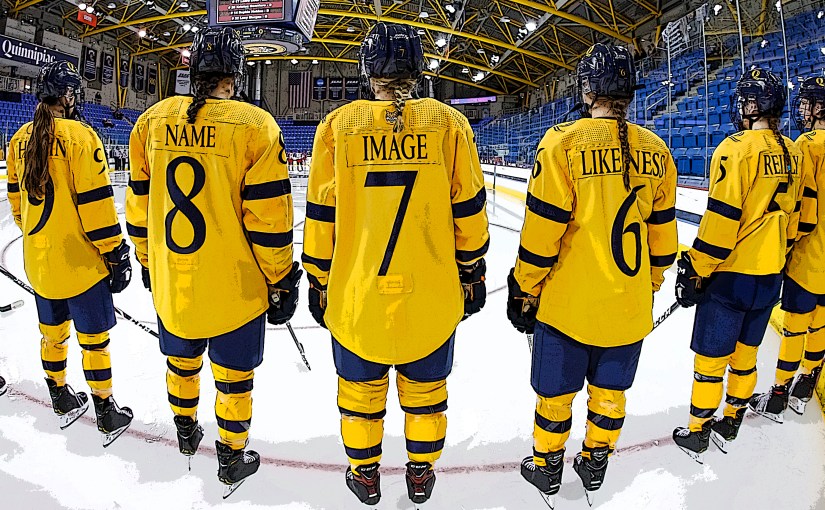
“For all the outrage, the real scandal is not that students are getting illegally paid or recruited.” Branch said. “It’s that two of the noble principles on which the NCAA justifies its existence—“amateurism” and the “student-athlete”—are cynical hoaxes, legalistic confections propagated by the universities so they can exploit the skills and fame of young athletes.”

-Taylor Branch, The Atlantic

On June 4, 2020, I sat down (virtually, of course) to talk to a few student-athletes of whom I work with every day in a normal week at Quinnipiac. They were all female and all play on the same team. I was curious to know what they already knew about the name, image and likeness rules and how I could take the information they gave me to apply it to my NCAA NIL Student-Athlete Toolkit.

A few things I discovered:

-The student-athletes knew the basics of what exactly name, image and likeness means.

-They knew the very basics of the old name, image and likeness rules. If approached by an outside party/sponsor about promoting a brand, they all knew to double-check with myself or our compliance office before taking any action. They knew they were not allowed to post anything on social media that promoted a brand that was not Quinnipiac. 

-One student-athlete brought up California being the first state to bring up legislation about student-athletes being able to compensate off their NIL before the NCAA.

-When asked if they would be open to taking advantage of opportunities that may come to them in a year, they said they would be open but “wouldn’t go out looking for them” and “would not want the added distraction during competition season”.

-They did not know about the new rule about institutions not being allowed to be involved in these new opportunities. 

-They mentioned that they don’t follow the NCAA on social media, and they normally get the new information from teammates or coaches.

From the information I gathered, I created the Table of Contents for the Toolkit:

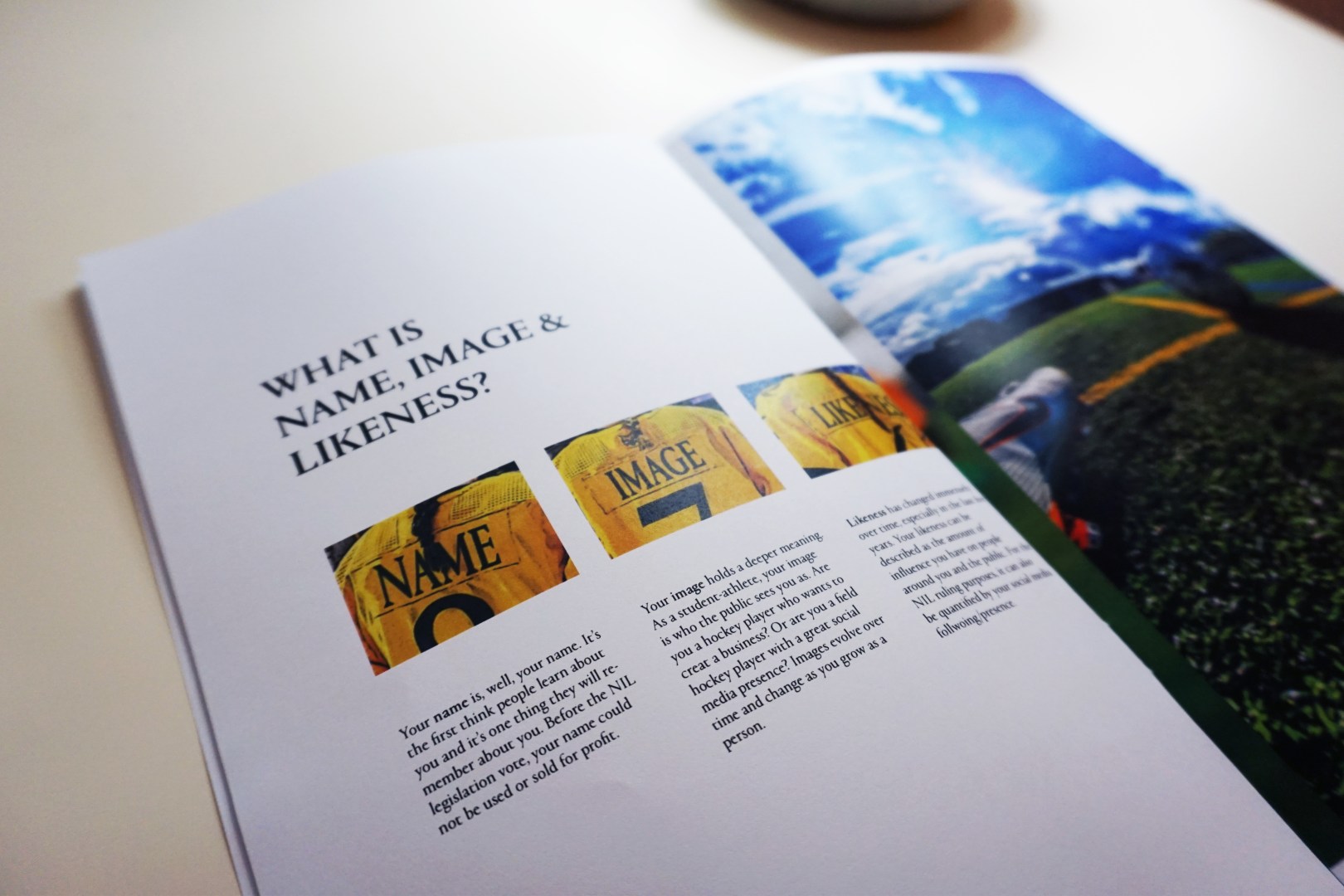
Section 1: What is Name, Image and Likeness?

            This section will explain the basics of what NIL is and how it pertains to student-athletes. 

Section 2: Old Ways: What Were the Rules?

Section 2 will briefly explain what the old rules were, and how the new legislation came to fruition, including the California law. 

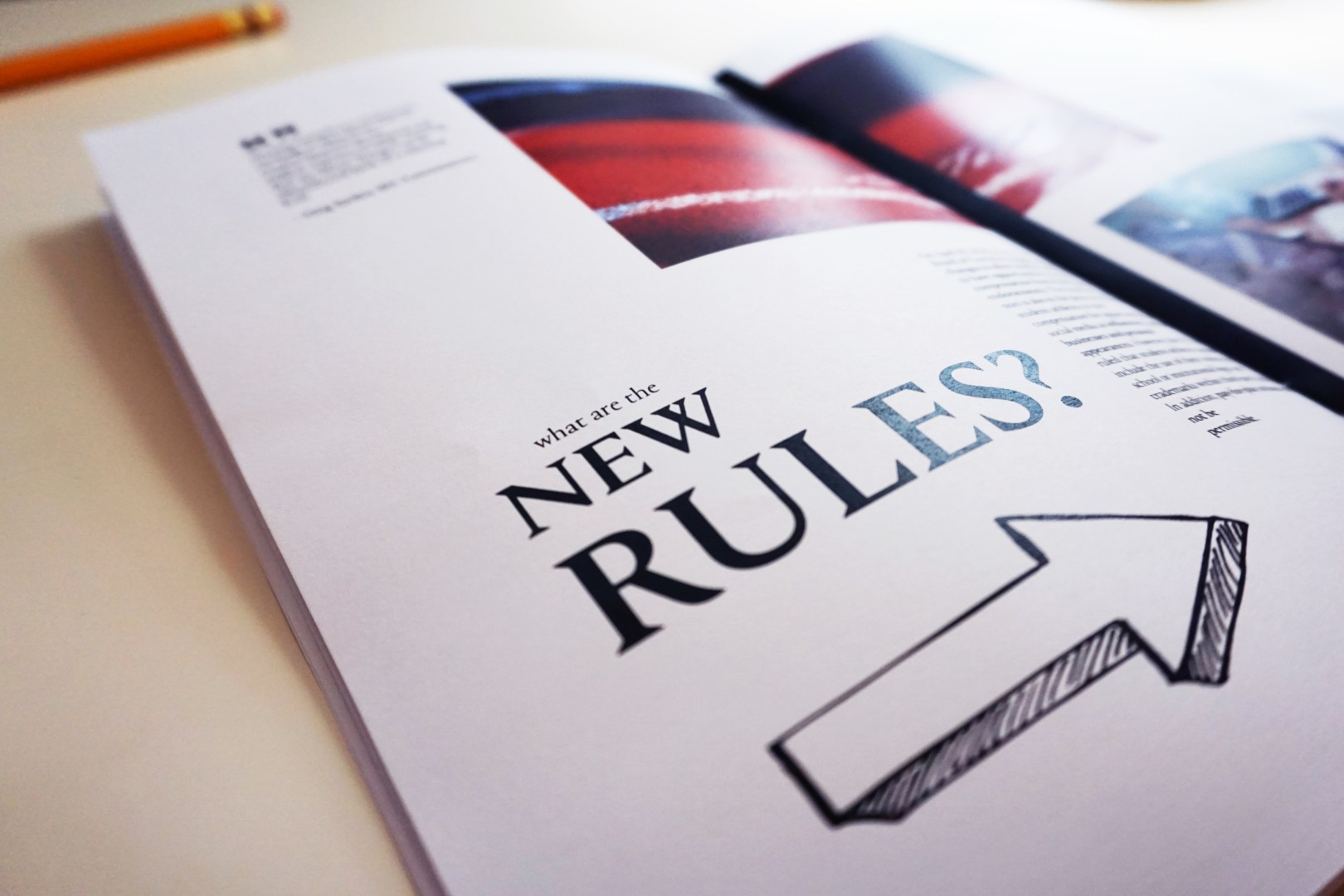
Section 3: What Are the New Rules?

This section will be two pages (leaving room for the new rules that are added down the line) and will explain in easy-to-understand language what the new rules entail. 

Section 4: What Does the Timeline Look Like?

This section will explain the voting timeline and when student-athletes would actually be able to being compensating off their NIL.

Section 5: What Opportunities Do I Have?

Section 5 will give examples for student-athletes to think about how they could profit off their NIL. From Instagram posts to signing autographs, there are many different ways student-athletes can earn money.

Section 6: What Will These Opportunities Involve?

How exactly will student-athletes make relationships, money and how will they deal with contracts? Will they need third parties’ involvement? This section will go into what is needed to make an opportunity happen.

Section 7: Differences for Male and Female Athletes?

There is no difference in the rulings for male and female student-athletes. But, this section can help female athletes understand the opportunities they have due to not having the same professional career opportunities that male student-athletes have after school.

Section 8: How Much Money Could I Realistically Make?

This section breaks down a chart from FiveThirtyEight that explains how much money student-athletes could potentially make based on their school, sport and following.

There is a lot of information to break down, but after hearing what student-athletes had to say about this ruling, I think it is essential to make the language easy to read. Breaking down the rules and the timeline will help student-athletes learn what is possible for them.

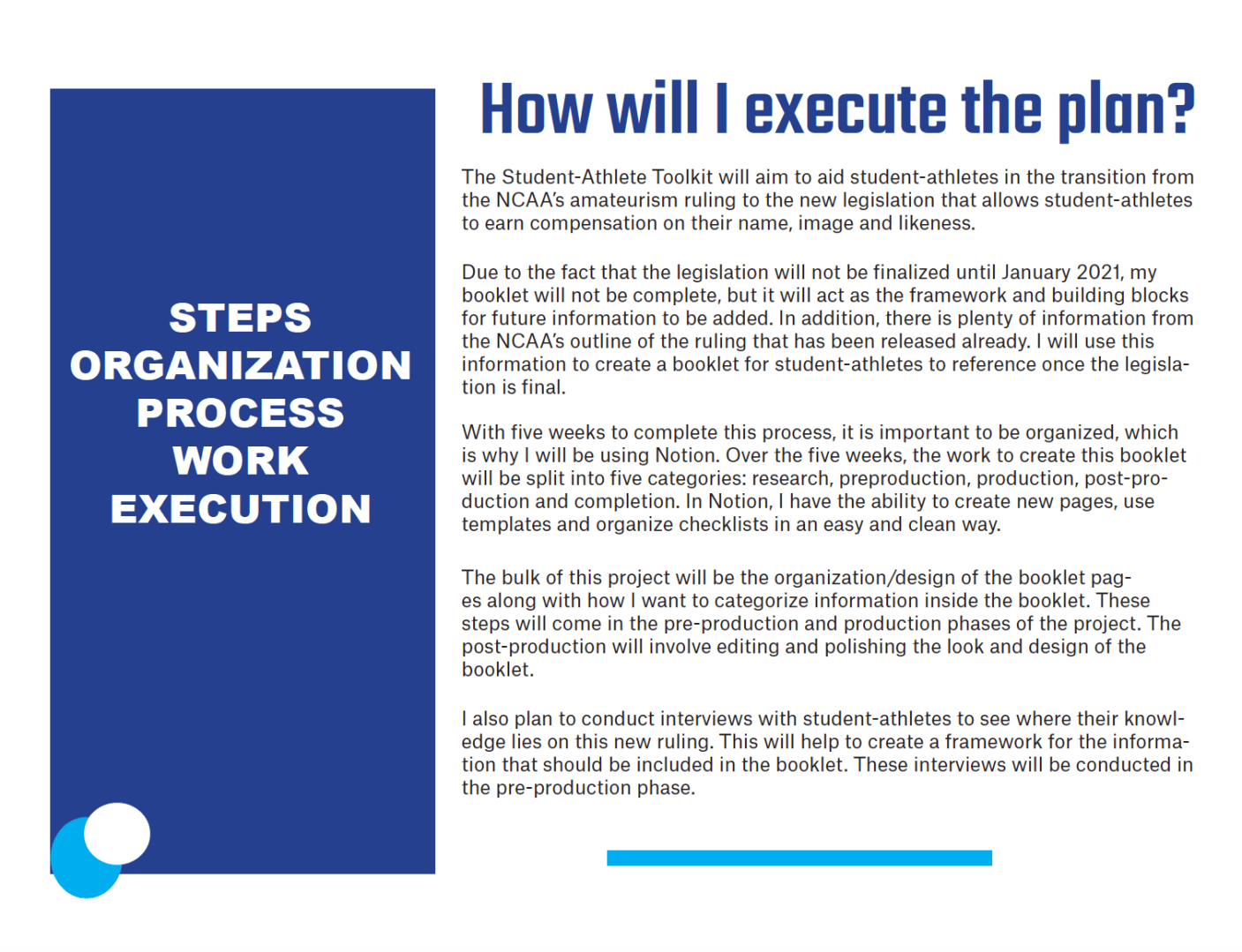
During this week of organization, I also created a Production Journal on Adobe InDesign. The Production Journal acts like a check list for each week in the remaining four weeks of the class.

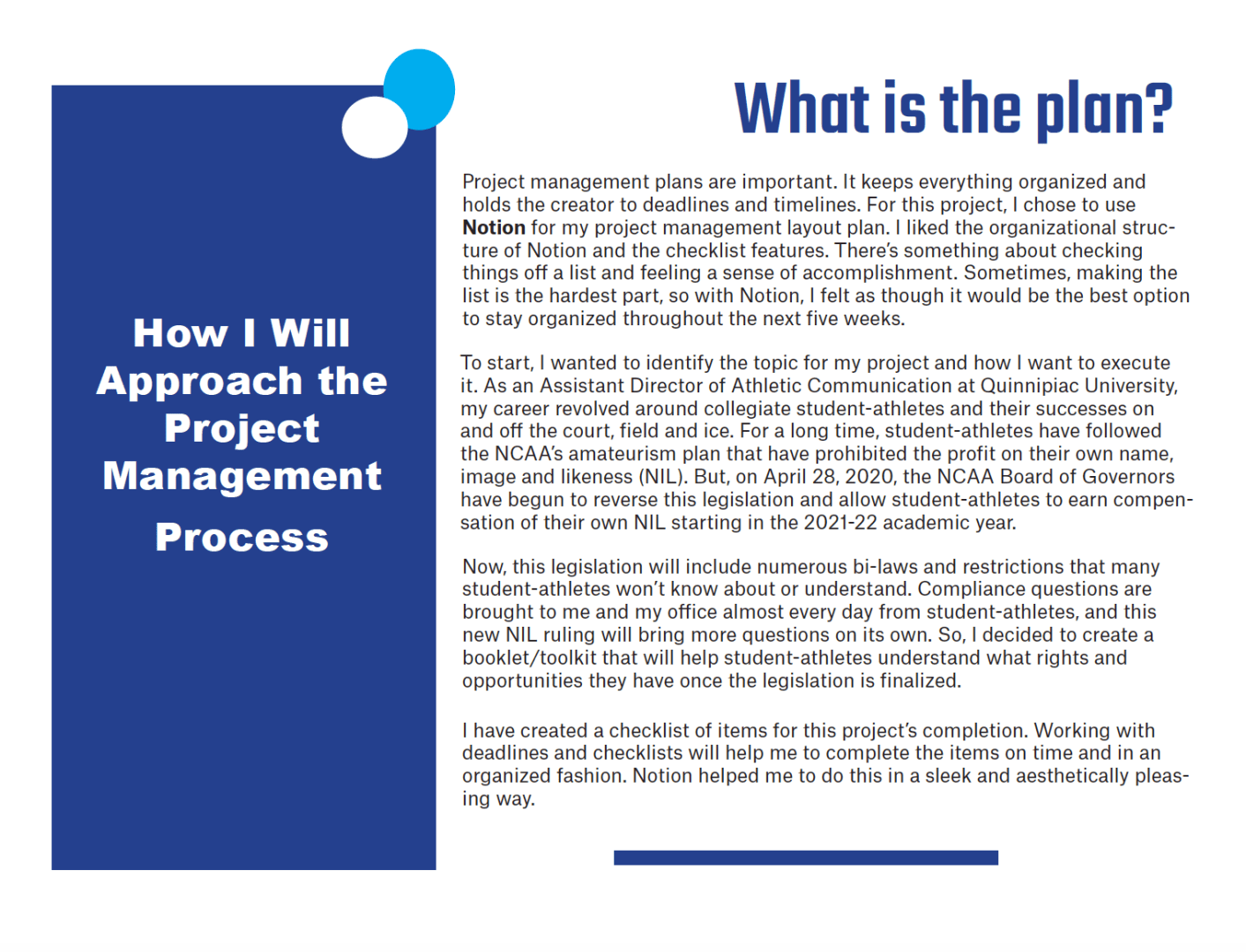
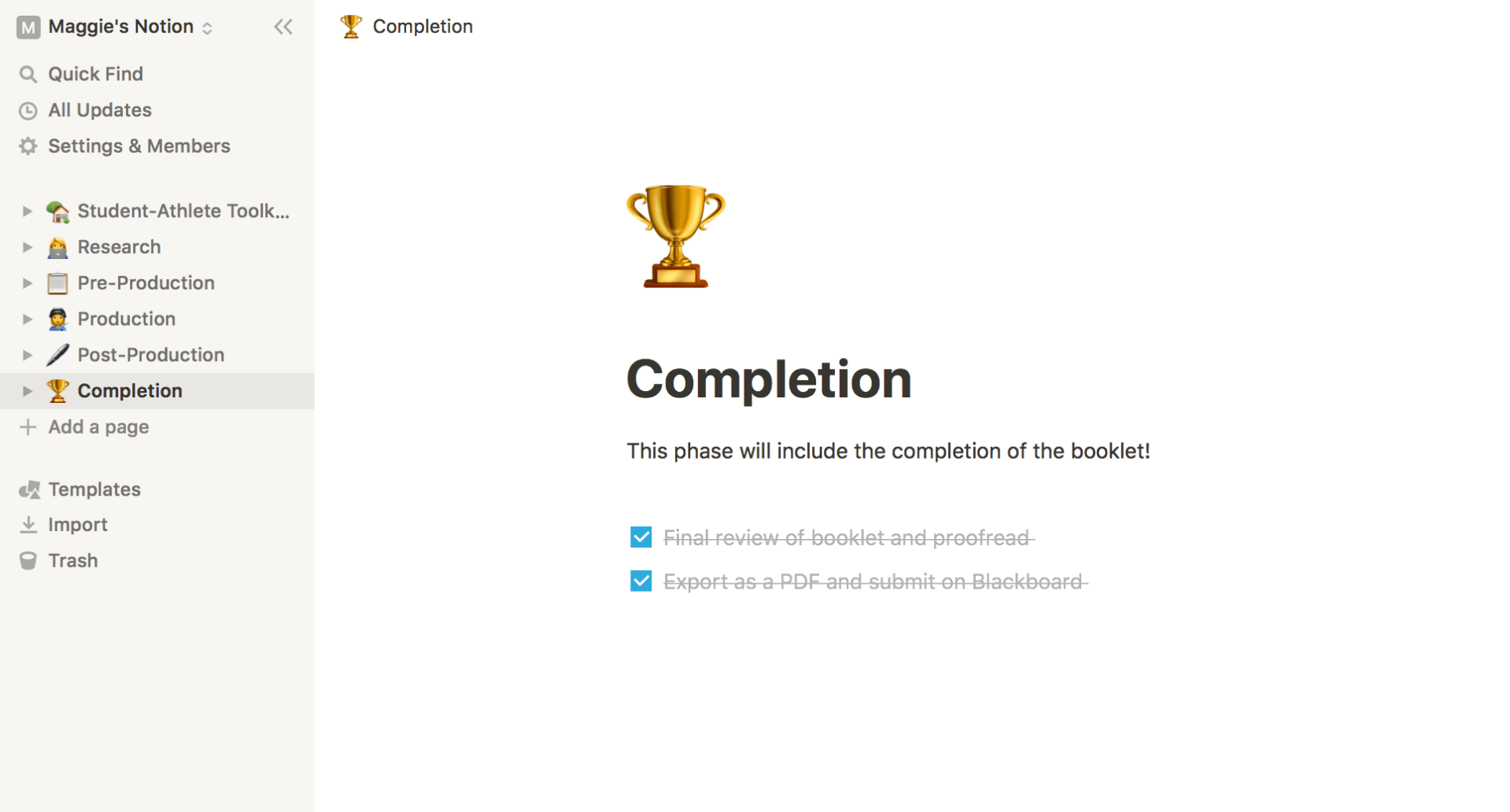
Project Management Plan: Student-Athlete Toolkit

Project management is important. It is how creators stay organized and accomplish tasks in a timely manner. Notion is a cool project management system that I decided to use for my project management process to develop a toolkit/booklet for NCAA student-athletes and the new name, image and likeness rules. 

Research 

The research phase of the project process will be ongoing and growing throughout the next five weeks. An annotated bibliography will be used to compile all research tools and sources throughout the process. On Notion, I noted the week-by-week process of adding annotations to the bibliography. 

Pre-production 

This phase of the project will include planning out pages and information, along with conducting interviews with student-athletes at Quinnipiac. This phase will be used to prepare and organize information before the production phase. I am interested to see what student-athletes know about the NCAA name, image and likeness regulations. The information I gather from the student-athletes will be used to decipher what information is especially important to use in the booklet. 

I came across the National College Players Association and was curious to see if student-athletes know what that organization is. The mission of the NCPA is to protect future, current and former college athletes. The NCPA is a great resource for student-athletes, but I am not sure many even know about it. I will use the Zoom interviews to see what they do know.

Production 

The production phase will include assembling the pages of the booklet in an Adobe InDesign document. InDesign is part of the Adobe Creative Cloud suite and is an awesome software for desktop publishing, so I decided to use that for the booklet. 

I will have to organize the booklet based on the information the NCAA has released and stated in the new rulings, and what information seems to be necessary for student-athletes.

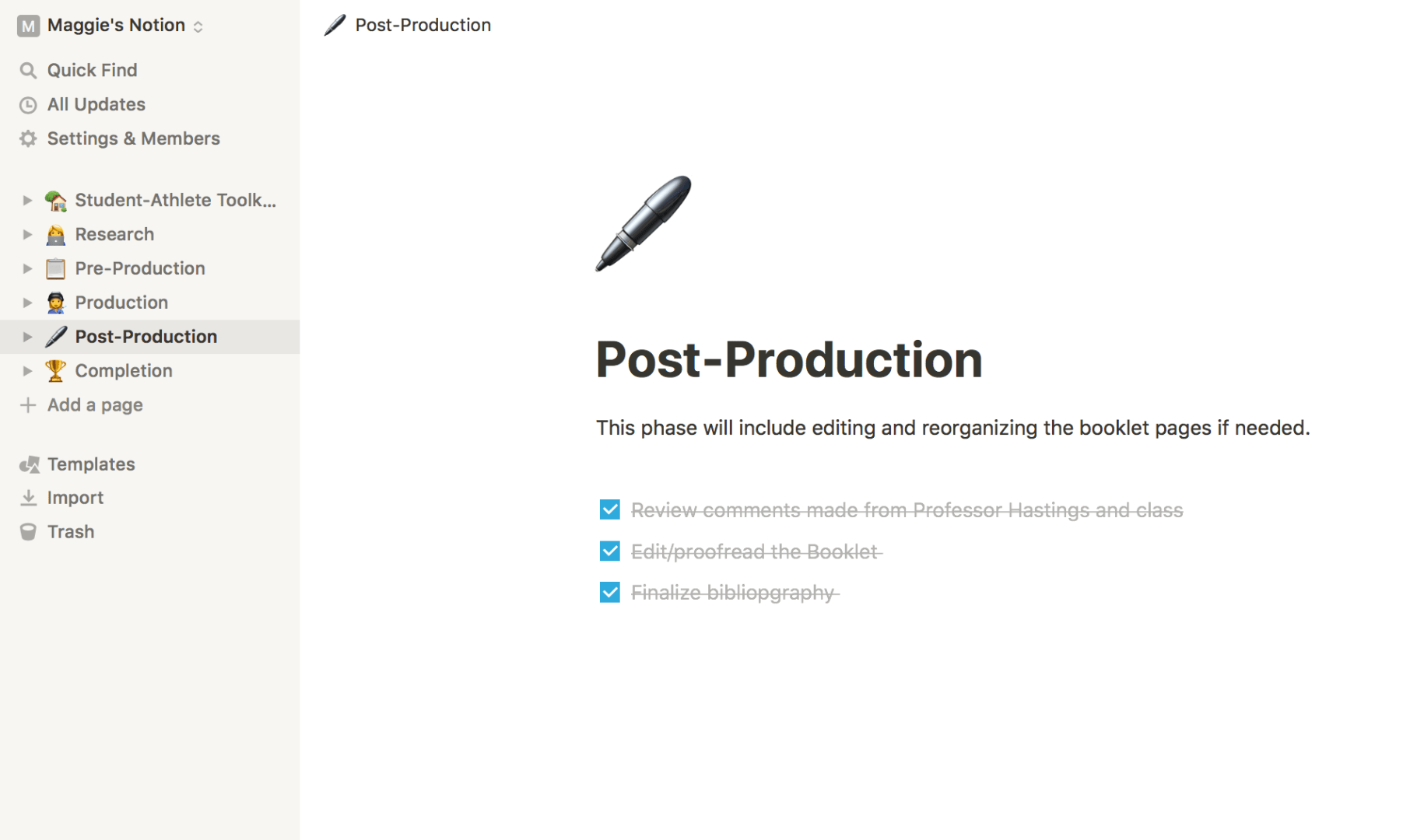
Post-Production 

This phase will include editing the booklet and proofreading. Reorganization of pages could be needed, so this phase will be essential after I have gone past the first three phases.