
When creating ideas or brainstorming, our minds are filled with thoughts and pictures of how we see the problem at hand. We think about solutions and take those solutions into the real world. If someone could see all of the sparks of ideas inside your mind while having a “brain storm,” can you imagine what it would look like on paper?
What would a lightning strike resemble in a brain storm? Would that occur when there is a jolt of creativity on a topic that had been building up in your mind? Sometimes the brain “storm” gradually builds up until there is a downpour of ideas. Mind maps can help facilitate those storms and get the ideas out of our minds and on paper.

Photo from Unsplash.
This idea of visualizing the thoughts in your mind and drawing them on paper is called mind mapping. There are many ways to help boost creativity in efficient ways, and many researchers, designers and creators use mind maps to help get their ideas rolling.
“The map looks like the picture of your brain. When one level is done and the whole picture is visual, your brain automatically starts developing those ideas, incrementing ideas to more ideas, assuming relationships between them,” (Razakhatskaya, 2016).
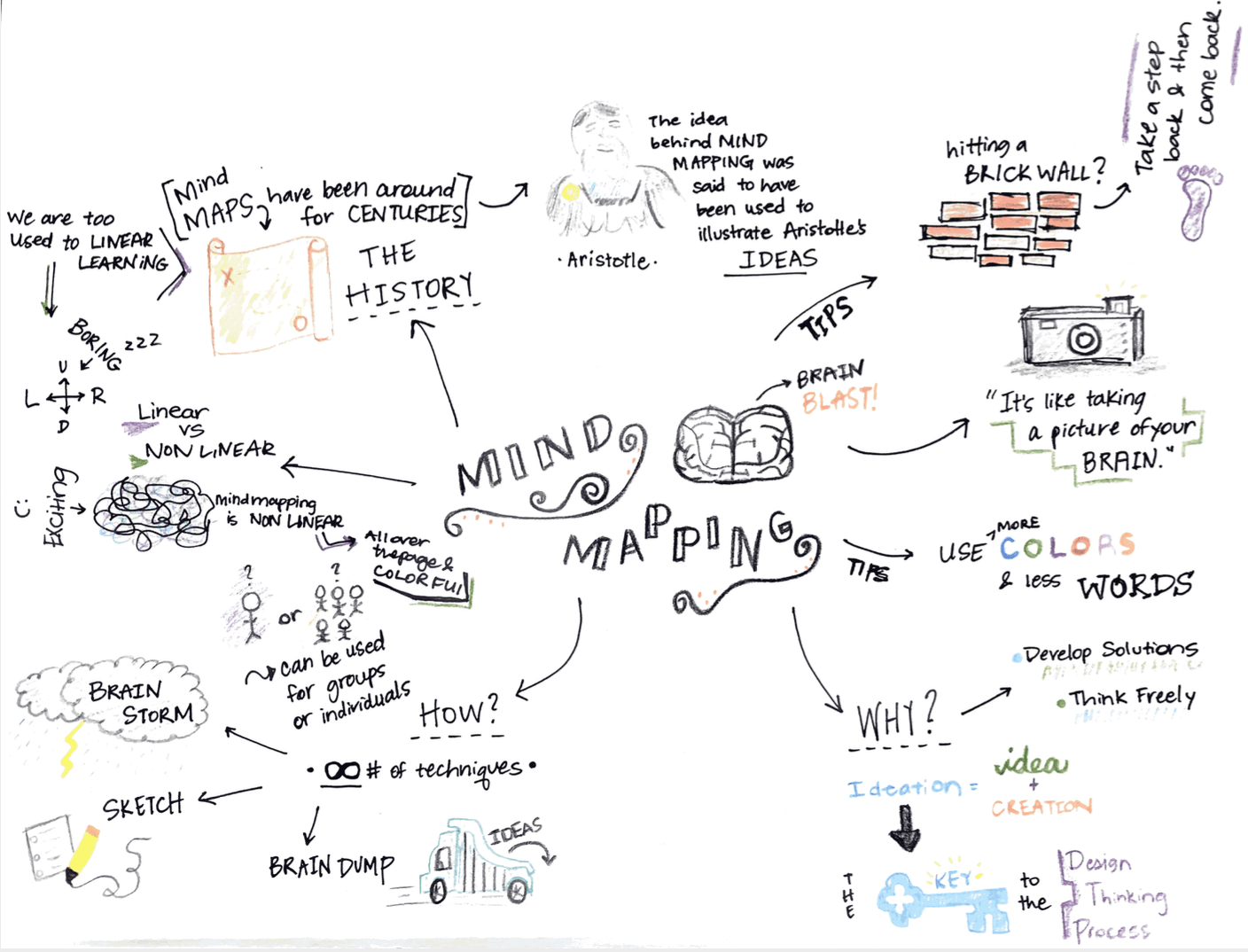
Mind maps, unlike some ideation techniques, can be used in a group or individual setting. They allow the creator to connect ideas together that may have not been thought to align at all. Mind mapping begins with a central image/idea and then branches out to connect with other words, ideas, images and concepts. The ideation technique of mind mapping is a non-linear process; ideas and concepts can be added or taken away at any point in the process, whereas linear thinking follows a step-by-step progression (Luenendonk, 2019).
The History of Mind Mapping
According to Luenendonk, Tony Buzan is frequently associated with the origin of mind maps. He popularized the term “mind mapping,” but the illustration of ideas in a “map” format has been used for centuries. There is evidence of similar strategies used in the third century to depict Aristotle’s ideas (Luenendonk, 2019).
Buzan claimed that mind maps help people visualize ideas in a more natural way because they are non-linear. He believes that the cerebral hemispheres can view the ideas in a mind map more efficiently and naturally.
Step-by-Step
Luenendonk also explains the six steps that you can use to create a mind map. To begin, you should start with a topic and put it into a visual form. Draw the image and add the words needed to the center of the page. When you begin in the center of the page, you allow yourself the freedom to move in all directions.
Next, you should decide how you want to structure your branches. After that, you should define each branch and add a key image as they come to you. As you continue, you can add smaller branches if you think of less-important ideas and add more ideas throughout the process. In the end, take a step back from your mind map and come to add any remaining ideas that come to you. Luenendonk also mentions that you should use color as much as possible and words as least as possible.
My Mind Map
I created a mind map on the history and background of mind mapping and how to be successful in a mind map endeavor. Here is a link to my mind map and a screenshot.
Conclusion
Mind maps are a great way to disconnect from technology and spark your inner-creative self. Using your mind in unconventional ways, like drawing a mind map, can help spark new ideas, too. We are bogged down with technology and screens; mind maps help us take a step back, find a creative spark and accomplish tasks.
References
Luenendonk, M. (20 Sept. 2019). Techniques for idea generation: Mind maps. https://www.cleverism.com/techniques-idea-generation-mind-maps/
Razakhatskaya, M. (3 Aug. 2016). Ideation & planning techniques – MindMaps. Medium. https://medium.com/@maryna_ct/ideation-planning-techniques-1-3-mindmaps-e4365df53f91
 MAGGIE PRUITT