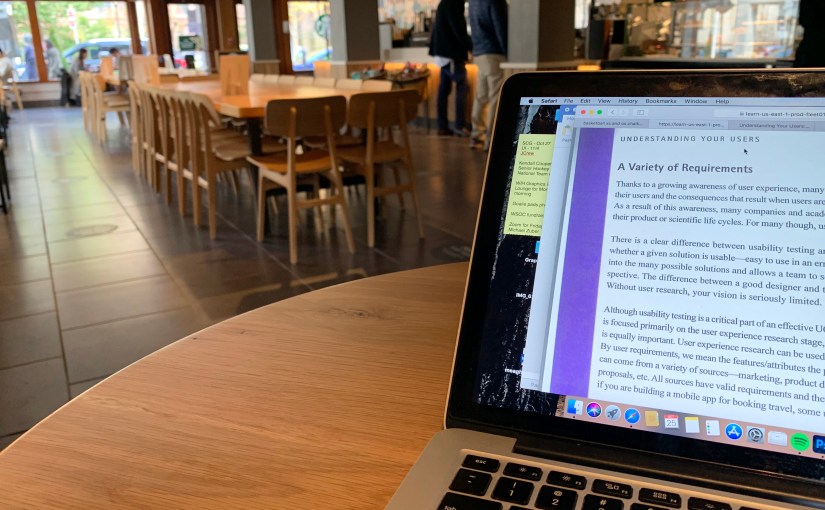
Design thinking.
What does this mean? We see the world around us and how it is built and created. We see how things have existed. Innovation has led to blending the two ideas of how things can be improved and how things have existed before.
Design thinking ideology is the idea that a hands-on approach to solving a problem can lead to innovation, which then leads to differentiation and a separation between competitors. Design thinking follows a framework that consists of three interconnected parts – understand, explore and materialize. From there, you can break down the framework even more to six parts – empathizing, defining, ideate, prototype, test and implement (Gibbons, 2016).
“Design thinking isn’t one thing,” Neil Stevenson, the executive portfolio director at IDEO Chicago said. “but a bundle of mindsets and philosophies all wrapped up in one term, which obviously has the potential to lead ambiguity and misunderstanding (Lahey, 2017).”
Design-thinking philosophies require a certain type of thinking from the designer; ego and personal ideologies must be pushed aside. In order to be successful, designers must put the users’ rational and emotional needs first (Lahey, 2017).
For example, when Amazon first started, it was primarily a book distribution company. People were able to buy and sell books. But now, as we have seen over the last 10 years or so, Amazon has transformed into a distribution giant that basically sells everything. The company saw a need from customers, and adapted their company and its navigation. People enjoy shopping online and receiving their items quickly and easily.
This is where User Experience (UX) comes in. Before this year, I did not know what UX was, but now I realize there is a need for people who help users have a better experience when navigating technology or trying to use a product or service, which is what UX is all about! When thinking about UX, it is important to understand that there is balance between understanding the differences in usability and user experience. Usability is more concrete and objectively product-based, whereas user experience is more subjective and based on the ideas of what humans need (Baxter, Courage & Caine, 2015).
There are numerous jobs that are involved in the entire UX process. From a usability specialist to a creative director, many people come together to have a successful UX for consumers.
Mental Models
When thinking about UX, it is also important to understand what influences our mental models. Mental models are the pictures we see inside of our heads that represent how something works or functions based on our own past experiences. Mental models influence how we solve problems and approach situations (Weinschenk, 2011).
In interface design, mental models refer to how people imagine the world, a device or a process. There are many examples of when people use their mental models incorrectly. For example, when someone presses a button to call the elevator, they will occasionally press it again thinking it will come faster. This is called the “more is more” philosophy (Rogers, Sharp, Preece, 2004).
“It is believed that the more times you press the button the more likely it will result in the desired effect,” (Rogers, Sharp & Preece, 2004).
Rogers, Sharp and Preece describe the “more is more” philosophy is interesting to think about. Naturally, as humans, we ideally understand that the more we practice something, the better we will be. But, in the sense related to the idea that doing something more will bring the result you want, the notion is not correct. When you think about it, it is all a little backwards. We are trained as humans to do things over and over, so when something does not go how we plan, we result back to what we know.
Understand Your Users
When I am looking to buy a new product, piece of clothing or furniture, I always like to read the comments and reviews. This section of a website is filled with valuable information for not only the people buying products, but also the creator. This is why it is important to know your products and use them yourself. If a customer has a complaint, and you do not know what the customer is referring to, this can create UX issues (Baxter, Courage & Caine, 2015).
User-Centered Design | User Requirements vs Business Requirements
The Satisfy the Cat video (here) showed great examples of how UX designers and creators must leave out their likes and dislikes to create the best experience for their client/consumer. In the video, the narrator explains that he as a human like chocolate and strawberries, but the cat does not. This is a simple example of showing how a UX designer cannot use their own likes and dislikes to influence the process of creating user-centered final product.
Generally, the user’s requirements are going to be a little different from the business’ requirements. But, in the end, both parties will have the similar goals. The user hopes to have an enjoyable experience and when that happens, the business will be able to sell the product and have a consistent customer.
References
Baxter, K., Courage, C., & Caine, K. (2015). Understanding your users: A practical guide to user research methods. Morgan Kaufmann Publishers Inc. July 2015.
Gibbons, S. (2016, July 31). Design thinking 101. Nielsen Norman Group. https://www.nngroup.com/articles/design-thinking/
Lahey, J. (2017, Jan. 4). How design thinking became a buzzword at school. The Atlantic. https://www.theatlantic.com/education/archive/2017/01/how-design-thinking-became-a-buzzword-at-school/512150/
Rogers, Y., Sharp, H., Preece, J. (2004). Interaction design.
Weinschenk, S. (2011, Oct. 8). The secret to designing an intuitive UX match the mental model to the conceptual model. UX Magazine. https://uxmag.com/articles/the-secret-to-designing-an-intuitive-user-experience
 MAGGIE PRUITT