
New York City is one of my favorite places in the world. I love the feeling you get when you look up at the sky and see a jumble of skyscrapers around you. I love the hustle and the madness of the city by day and night.
You can find yourself on the crowded sidewalks of Times Square or in the quieter villages of the Upper West Side. Having been to the city countless times, I feel as though I have good grasp on where things are and where I am while walking around, but I can also feel turned around a lot, too.

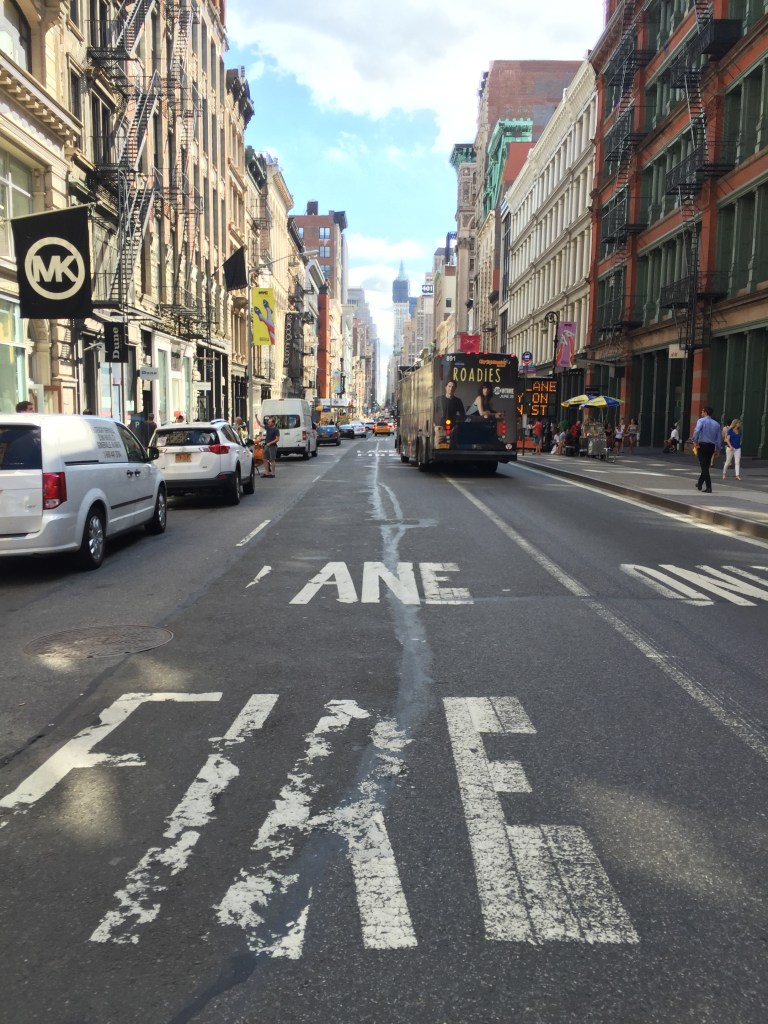

When I walk up the steep steps at a subway stop, I look up and sometimes know exactly where I am. Other times, I look around and can’t tell which was is north or south.
Without my iPhone, navigating a city like New York would be difficult. Google maps has helped me in so many situations – in times where I am driving to a place I’ve never been to or just looking for a place to eat. We rely on our phones for a lot of things, but knowing where we are and where we want to go are some of the most important.
Not only do we rely on the phone itself, but more importantly, we rely on the apps that make up the phone, as described by Adam Greenfield in “Sociology of the Smartphone.”
“The smartphone is not particularly useful. It can be used to make voice calls, certainly; it generally comes loaded with a clock, calendar, weather and map applications, a Web browser, and a stock ticker. But the overwhelming balance of its functionality must be downloaded from the network in the form of apps” (Greenfield, 10).
Before reading Greenfield’s explanation of this idea, I had never thought of the iPhone as just a hosting device. But, without the apps, there wouldn’t be as much of a specialized use to the iPhone. I do believe, however, one of the most exciting parts of the iPhone is the camera. It has evolved tremendously over the years, and it is one of the best parts of the phone.
The evolution of not only the camera, but the entire phone is a fascinating timeline to examine. The first iPhone was unveiled in 2007 (Greenfield, 8), and I was in the fifth grade. I distinctly remember the news of the new gadget coming out – it was so futuristic. The size, the small circles known as applications, the invisible keyboard, the touch screen.
The fact that you could touch the screen and things would move was so new and exciting. Everyone wanted one, but they were really expensive at the time. I remember not really knowing anyone my age who owned one. It was more for adults who used it for work.
The first iPhone I owned came in my junior year of high school – five years later. My friends, classmates and I went through the flip phone era before any of us had iPhones, which I am thankful for.
Has this accelerated transition of technology been for the better or for the worse? Greenfield examines this question with the idea that there probably isn’t a correct answer. I’ve found that we as humans are trained to always strive to be better and do better. We have the idea that working hard and creating news ideas is just how we function.
Is there a more efficient way to do this and to make things easier for people? How can we improve this product? How can we make our business better?
Tech companies everywhere try to answer these questions, and in turn, we arrive at where we are today, with iPhones attached to us like we are handcuffed to them.
Dear So-and-So, Sorry for the Late Email
Now more than ever, people receive work-related alerts throughout the day and into the late hours of the night. The dam of life is open and email inboxes are flooding.
Employees are pressured into returning emails almost immediately after receiving them, including myself. (Texting has really become the new email, but we will save that for another discussion). Work efficiency is down and unread mail is up. Are companies looking to fix this?
Well, according to Clive Thompson, Adam Gazzaley and Larry Rosen, some companies are trying to help their employees out. Edelman, a public relations firm in Toronto, uses a 7-to-7 rule, where employees are encouraged to only respond or send emails during the hours of 7 a.m. to 7 p.m. (Thompson, 2014).
I thought this was a great strategy to use, but unfortunately, some companies and employees can’t always act on that rule. Time sensitive issues can arise, and a response at a late hour is occasionally required. However, I believe companies can take the time to implement some form of this rule.
In Cal Newport’s Deep Work, he emphasizes the fact that people would rather respond quickly to an email than take the time to have a meeting or talk on the phone.
“We find ourselves in distracting open offices where inboxes cannot be neglected and meetings are incessant – a setting where colleagues would rather you respond quickly to their latest e-mail than produce the best possible results” (Newport, 97).
I find this to be very true in a typical office setting. I rarely have meetings anymore, but I find that meetings are really helpful. In addition to actually sitting and talking to people that you work with, getting up and physically moving to a different space and not looking at a computer is always a good thing.
I am all for meetings, but people nowadays would rather just send you a quick email than get up and communicate out loud.
It turns out, the idea of being more efficient with fast responses on our smartphones actually makes us less efficient. It will be interesting to see what a typical office is like in five to ten years.
References
Gazzaley, A. Rosen, L. (2018, Jan. 8) Remedies for the distracted mind. Retrived from https://behavioralscientist.org/remedies-distracted-mind/
Greenfield, A. (2017). Sociology of a smartphone. Retrieved from https://longreads.com/2017/06/13/a-sociology-of-the-smartphone/
Newport, C. (2016). Deep Work. London: Grand Central Publishing.
Thompson, C. (2014, Aug. 28). End the tyranny of 24/7 email. Retrived from https://www.nytimes.com/2014/08/29/opinion/end-the-tyranny-of-24-7-email.html
 MAGGIE PRUITT